
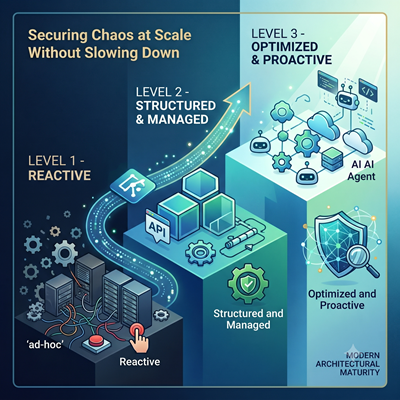

For a long time, I wanted to write a blog post talking about how the software development and cybersecurity world have matured over the years.
In this blog post, I will share my insights from organizations I came across in both the SDLC and cybersecurity domains.
Although traditionally you can break the maturity levels into 5 levels, I decided to make things simpler and break them into 3 levels (from ad-hoc to fully optimized). You can look at the various levels and figure out where your organization is on the scale.
Level 1 – Reactive
The initial level is considered the lowest maturity.
The infrastructure is deployed manually (usually based on physical or virtual machines), and if applications have UI, everything is configured in a click-ops style.
Code is written to meet immediate deadlines.
Standard workflows are just beginning to be documented.
There are almost no design considerations. Everything is ad-hoc, probably monolithic applications, and most likely undocumented architecture.
There is basic cyber hygiene. Protections are localized, perimeter-focused, and highly reactive. Security patches are deployed manually. Passwords are static or manually rotated at very long time intervals. MFA is rarely used, and auditing is either not configured, stored locally, not sent to a central logging mechanism, or not reviewed at all.
Resources are deployed with almost zero cost considerations (such as over-provisioned static resources, unmonitored cloud spend, etc.)
When looking at resiliency, in most cases, resources are deployed without redundancy (i.e., single point of failure), and in the best case, there are manual backups.
Level 2 – Structured and Managed
The second level is considered much more mature than the initial one.
Deployment is done based on containers, and very commonly on top of Kubernetes.
Automation is part of considerations such as deployment, testing, configuration, etc.
Engineering processes and CI/CD pipelines are standardized across the company.
Teams follow documented, repeatable workflows.
In terms of design considerations, we commonly see modular, service-oriented architecture and structured API design.
Risk assessments are routine. Security policies are formalized, and access controls are structured. It is common to see at this level implementation of SCA (Software Composition Analysis) and SBOM (Software Bill of Materials), as part of CI/CD pipelines, automated patching, and replacement of static passwords with passkeys or even passwordless authentication.
It is common to see design-stage secure coding reviews and manual STRIDE mapping.
When thinking about cost management, it is common to see the implementation of tagging strategies, scheduled resource scaling, and cost allocation.
When looking at resiliency, resources are deployed in multi-AZs, and disaster recovery plans are documented.
At this stage, we begin to see sustainability considerations, such as right-sizing underutilized compute instances.
Level 3 – Optimized and Proactive
This is considered a fully optimized level.
It is common to see cloud-native applications, use of microservices, event-driven patterns, and use of Serverless technologies.
We begin to see the implementation of GenAI technologies (such as AI agents, skills, etc.) and heavy use of non-human identities (for app-to-app communication or for AI agents).
Continuous threat hunting, automated incident response, and zero-trust verification for every entity.
It is common to see automated continuous Threat-Modeling-as-Code embedded in repositories. Threat modeling is dynamic, automatically updating when architectural changes are pushed to Git.
When thinking about cost management, it is common to see real-time anomaly detection and automated cost optimization policies.
When looking at resiliency, we begin to see the use of chaos engineering and active-active multi-region self-healing architectures.
In terms of sustainability, we see carbon-aware architectures and scheduling heavy batch jobs during peak renewable energy hours.
Summary
In this blog post, I have reviewed multiple pillars of modern architectural designs.
Perhaps your organization is graded high in some aspects (such as automation or security), while graded low on other aspects (such as cost management or sustainability).
Regardless of where your organization is located on the scale, there is always the next level your organization can mature in each pillar.
Disclaimer: AI tools were used to research and edit this article. Graphics are created using AI.
About the Author
Eyal Estrin is a cloud and information security architect and AWS Community Builder, with more than 25 years in the industry. He is the author of Cloud Security Handbook and Security for Cloud Native Applications.



Top comments (13)
Managing security in dynamic, large-scale cloud infrastructures is a massive challenge, and balancing speed with strict safety protocols is key. Mitigating digital risks requires implementing clean architecture and predictable paths within otherwise chaotic systems. It is fascinating to look at how different industries develop their automated controls, user authentication, and data compliance rules under pressure. When you need to step away from infrastructure monitoring and want to observe high-performance web engineering and interactive design in a different space, you can check out Сhicken road
A clear maturity model can help organizations understand where their software development and cybersecurity processes still need improvement. Moving from reactive practices toward optimized workflows makes it easier to identify risks earlier and respond more consistently. More information is available at spin-mills.co.nl/.
Securing chaos at scale requires balancing speed, resilience, and visibility. By automating security controls, monitoring continuously, and integrating protection into workflows, organizations can innovate rapidly while maintaining strong security and operational stability.
The author, Eyal Estrin, does a great job outlining three distinct levels of maturity—from ad-hoc manual deployments with basic cyber hygiene all the way to proactive, cloud-native environments with automated threat modeling and chaos engineering. I found myself mentally placing our own processes somewhere between Level 2 and Level 3, which was a helpful reality check. It's not just about checking boxes for security; it's about building resilience without creating bottlenecks that frustrate everyone. And speaking of balancing enjoyment and safety, this discussion reminds me of something I've been exploring on the side. If you're looking for a platform that values transparency and fairness while still offering a bit of excitement, I'd recommend checking out spin mama It’s a solid example of an online platform that seems to prioritize clear communication and security, much like what we should all be aiming for in our development practices.
This is a really solid breakdown — I love the simplicity of the three-level model, especially how it makes it easy to assess where your organization stands across different pillars without getting lost in the traditional five-level complexity. The progression from reactive to optimized feels practical and achievable, with clear markers like moving from manual backups to chaos engineering and carbon-aware architectures. If you're into cloud architecture or security insights, magneticslots has some other interesting content worth checking out.
I really enjoyed reading “Securing Chaos at Scale Without Slowing Down” because it highlights the challenge of maintaining strong security in fast-moving, large-scale systems. I liked how it reflects the balance between protecting infrastructure and keeping performance and development speed intact, especially in complex distributed environments. It also shows how modern engineering teams rely on automation, monitoring, and smart security practices to manage “chaos” without creating bottlenecks. I personally think this topic is important because it emphasizes that security and speed don’t have to be opposites—they can work together when systems are designed well.
Scaling security effectively requires moving from reactive fixes toward structured, automated, and proactive processes. Clear governance and continuous optimization can help teams reduce risk without slowing down development. More information is available at bet-on-win.org/.
This is a great overview of how organizations evolve in software development and security maturity. Moving from reactive processes to optimized systems takes time, but creating better documentation, automation, and security practices can make a huge difference. It’s interesting to see how teams can improve without sacrificing speed by building smarter workflows. I was also exploring different online resources recently and came across Win Airlines, which was an interesting discovery. Thanks for sharing these insights!
I like the simplified three-level approach because it's much easier to relate to than overly complex maturity models. Security and development really work best when they're built into the process from the beginning instead of being treated as separate steps. After reading tech articles like this, I usually take a short break at cazeuss.it/ before diving back into work. Looking forward to the rest of your insights!
Securing Chaos at Scale Without Slowing Down requires a balance between strong security practices and operational efficiency. By automating monitoring, applying proactive risk management, and integrating security into development workflows, organizations can maintain resilience while supporting rapid innovation and growth. Discover more insightful articles at Happy Jokers