
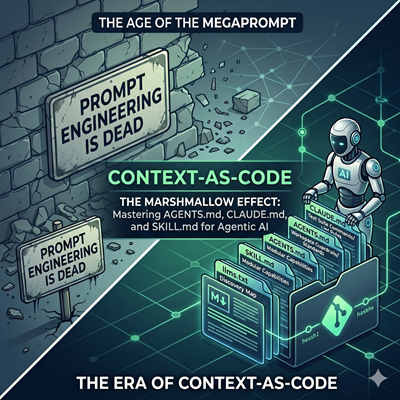

Since the early days of GenAI, when ChatGPT launched in late 2022, we began using prompt engineering to direct chatbots (and later LLMs) with human language instructions to provide us answers to questions or take actions (in a high-level…)
In 2025, companies such as OpenAI and Anthropic began releasing a new agentic concept called “AI Agent”, an autonomous system that uses an AI model as its "brain" to perceive an environment, make independent decisions, and execute multi-step tasks using digital tools. Unlike passive chatbots that just answer questions, an agent can plan its own workflow, run commands, and browse the web to achieve a specific goal without constant human supervision.
In this blog post, I will explain the concept of Context-as-Code and share some coding examples.
Introducing Context-as-Code
Traditional prompting is a one-way street. You type out your instructions, send them off, and that text never changes.
AI agents operate completely differently. Because they work on their own, every action they take creates a mountain of new data. Every time an agent opens a file, checks an error, or runs a tool, it adds more information to the pile, which quickly overwhelms a standard chat screen.
Context-as-Code treats the agent like a stateless compute engine. Instead of a massive text prompt, we use version-controlled files (CLAUDE.md, AGENTS.md) to establish structural boundaries, separating the permanent project rules from the temporary, dynamic session memory.
Context-as-Code transforms loose AI prompts into version-controlled engineering assets by using structured Markdown files to establish permanent, auditable boundaries directly within a project repository.
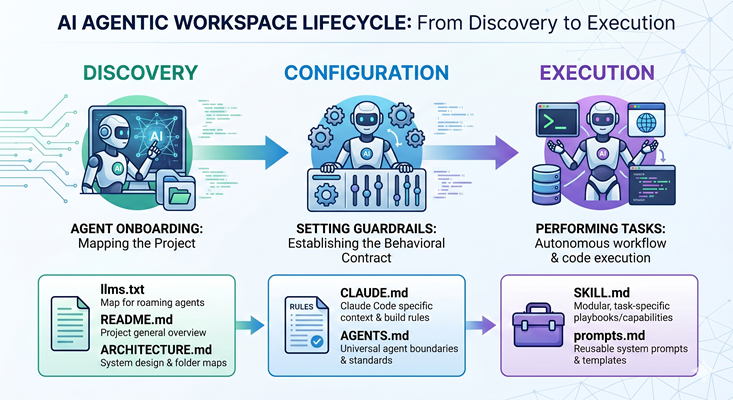
The Discovery Stage (Onboarding the Agent)
Before an agent writes a single line of code, it must parse the overall project layout. These files act as the "map" for an incoming AI.
llms.txt
Serves as a lightweight text directory mapped out in Markdown format. Placed at the root of a project or website, it acts exactly like a robots.txt for AI. It points roaming models and agents to the exact location of your documentation and architecture maps so they don't get lost crawling messy HTML or redundant folders.
Reference:
ARCHITECTURE.md
Outlines the systemic design rules, folder hierarchies, and database schemas. Agents read this during the planning phase of a task to ensure a newly generated feature doesn't conflict with core infrastructure boundaries.
Reference:
The Configuration Stage (Setting Workspace Rules)
Once the agent understands the codebase, it requires a strict behavioral contract. These files dictate the workspace boundaries (Always Do / Never Do) that govern every automated action.
AGENTS.md
Establishes cross-tool workspace guardrails and strict coding boundaries. It tells any agent entering the repo how to format code, run local builds, and what architectural limits to never cross. This file is fully supported by OpenAI and Cursor.
References:
- AGENTS.md
- A stale AGENTS.md is worse than no AGENTS.md
- Agent Skills Explained: From Basics to Advanced!
CLAUDE.md
This file serves as the dedicated, platform-specific behavioral contract for Anthropic's toolchain. It establishes an immediate project context by outlining exact test suite execution commands and lint rules, which prevents the agent from getting confused mid-session.
Natively executed by Anthropic's Claude Code CLI and fully integrated into Microsoft Visual Studio Code (VS Code), which automatically detects and honors CLAUDE.md memory files and workflows.
References:
The Runtime & Execution Stage (Performing the Task)
When a user tells an agent to run a specific procedural task (e.g., "Review this PR for security leaks" or "Deploy this service"), the agent switches from broad guardrails to highly specific, dynamic execution instructions.
SKILL.md
Defines a modular, task-specific capability or playbook. It utilizes YAML frontmatter metadata so an agent can quickly scan what the skill does, only loading the heavy step-by-step instructions when a user explicitly requests that specific workflow.
This file is supported by Claude Code, Cursor Editor, GitHub Copilot Agent Mode, Codex CLI, and Gemini CLI.
References:
prompts.md
Houses version-controlled, multi-shot system prompts or reusable engineering templates. Instead of hardcoding prompts into application backends, these files turn complex agent prompts into modular workspace assets.
Widely used in prompt registries across custom enterprise stacks (AWS Bedrock, OpenAI Assistants API) and natively inside VS Code's extension prompt libraries.
Reference:
Below is a visualization of the AI agentic workspace lifecycle:
Summary
The shift from manual prompt engineering to autonomous AI agents requires a new approach called Context-as-Code. By replacing static prompts with version-controlled Markdown files inside a repository, developers can establish clear architectural maps, behavioral guardrails, and execution playbooks that guide an agent safely through its onboarding, configuration, and runtime lifecycle stages.
Using structured files like CLAUDE.md, AGENTS.md, and SKILL.md turns vague instructions into auditable engineering assets that keep an agent's memory clean and predictable. Because autonomous agents can independently alter code and run terminal commands, teams should actively expand their knowledge and gain hands-on experience in development settings before deploying these agentic workflows into production.
Disclaimer: AI tools were used to research and edit this article. Graphics are created using AI.
About the Author
Eyal Estrin is a cloud and information security architect and AWS Community Builder, with more than 25 years in the industry. He is the author of Cloud Security Handbook and Security for Cloud Native Applications.



Top comments (21)
Prompt engineering is evolving as AI systems become better at handling richer context, tools, and structured information. Treating context as part of the application itself can make AI-assisted workflows more consistent and easier to maintain. More information is available at bets24.com.de/.
Interesting perspective. As AI agents become more capable, managing context is becoming just as important as writing good prompts. Treating context like code with versioning, structure, reusable components, and clear rules can make AI workflows much more reliable, especially for complex DevOps and automation tasks. For a break from coding, I also use blox fruit values to check trading values and game updates.
The framing of Context-as-Code as a shift from static prompts to version-controlled behavioral contracts is a genuinely useful mental model — it brings software engineering discipline to what has largely been an ad hoc practice. The distinction between permanent project rules and dynamic session memory is particularly important as agents grow more autonomous, since an agent operating on stale or ambiguous context can cause real damage in a production environment. Files like CLAUDE.md and AGENTS.md essentially serve as the institutional memory that keeps multi-step workflows predictable and auditable across sessions. As agentic tooling matures, treating these configuration files with the same rigor as application code will likely become a standard team practice rather than an optional best practice.
“Since the early days of GenAI and the launch of ChatGPT in 2022, prompt engineering became an important way to guide AI systems using natural human language. It helps users get better, more accurate, and more useful responses by clearly instructing the model what to do.”) [[The Spike mod APK]
I really enjoyed reading this article because it challenges the common belief that prompt engineering is the main skill for working with AI, and instead shifts the focus toward “context-as-code,” which feels like a more scalable and structured way of thinking. The idea that systems should carry reusable, modular context rather than relying on perfectly crafted one-off prompts is really interesting, especially for teams building real-world AI applications. I also liked how it framed AI interaction less like “writing magic prompts” and more like designing proper systems and workflows, which is a more sustainable approach in the long run. It also reminded me of PlayPelis APK, where the real value isn’t just one feature, but the overall structured experience that makes content easy to access and reuse. I personally think this shift could make AI development more like software engineering than creative guessing. Do you think “context-as-code” will actually replace prompt engineering, or will both approaches continue to coexist?
It means traditional “prompt engineering” (carefully crafting prompts) is becoming less important Mincerft APk.
Instead, AI systems now rely more on structured, reusable context like “code” that guides behavior consistently.
Excellent overview of how AI development is evolving beyond traditional prompt engineering. The idea of Context-as-Code is particularly valuable because it introduces structure, version control, and clear boundaries for autonomous agents, making their behavior more predictable and auditable. Treating context as a managed asset rather than a large prompt feels similar to how structured systems are used in data processing tasks such as codice fiscale calcolo and decodifica codice fiscale , where clear rules and well-defined formats help ensure consistent and reliable results.
Prompt engineering is evolving rather than disappearing. Context-as-Code emphasizes structured data, reusable instructions, and system-level context to improve AI reliability. The future combines thoughtful prompts with well-managed context, creating smarter, more consistent, and scalable AI applications.
This whole evolution from manual prompting to structured context management reminds me of how some platforms have become incredibly streamlined and user-friendly over time. For instance, when I want to take a break from all this complex tech talk and just relax, I appreciate a platform that makes everything clear and straightforward, like afk spin Casino The experience there is the complete opposite of chaotic; it's well-organized and easy to navigate, which is a nice contrast to the rapid, sometimes overwhelming changes we see in the AI space. It's a reminder that while some things are getting more complex, others are focusing on simplifying the user experience.
Excellent perspective. As AI agents become more autonomous, structured approaches like Context-as-Code can provide better governance, consistency, and scalability than traditional prompt engineering alone. Clear documentation, version-controlled instructions, and reusable workflows help teams manage complex AI-driven projects more effectively. For those interested in exploring AI tools and conversational workflows, free ai chatbot platform offers a practical way to experience modern AI interactions and prompt-based automation.