
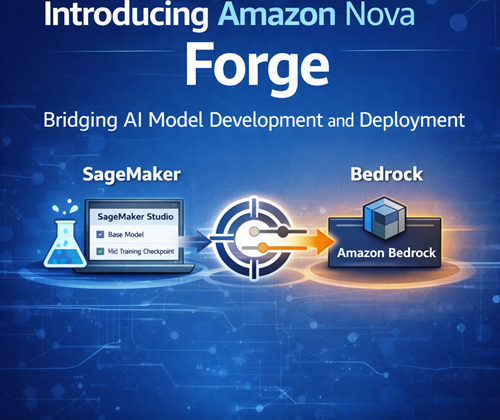

Amazon Nova Forge is a development environment within Amazon SageMaker AI dedicated to building "Novellas" - private, custom versions of Amazon’s Nova frontier models.
Unlike typical AI services that only allow you to use a model or fine-tune its final layer, Nova Forge introduces a concept called Open Training. This gives you access to the model at various "life stages" (checkpoints), allowing you to bake your company’s proprietary knowledge directly into the model’s core reasoning capabilities.
This blog post is an introduction to Amazon Nova Forge and what makes it unique in the training process.
What Makes it Different?
Prompt engineering and RAG provide external context but fail to change a model's core intelligence. Standard fine-tuning also falls short because it happens too late in the lifecycle, attempting to steer a "finished" model that is already set in its ways. Nova Forge solves this by moving customization earlier into the training process, embedding specialized knowledge where it actually sticks.
Nova Forge occupies a unique middle ground between Managed APIs (Bedrock) and building from scratch.
- Amazon Bedrock: Bedrock is for consuming models. You can fine-tune them, but you are working on a "black box" model. Nova Forge is for building the model itself using deeper training techniques.
- Azure AI / Google Vertex AI: While Azure and GCP offer fine-tuning, they generally don't provide access to intermediate training checkpoints of their frontier models. Nova Forge allows for Data Blending, where you mix your data with Amazon’s original training data to prevent the model from "forgetting" how to speak or reason.
Terminology
- Novella: The resulting custom model you create. It’s a "private edition" of Nova.
- Checkpoints: Saved "states" of the model during its initial training (pre-training, mid-training, post-training).
- Data Blending: The process of mixing your proprietary data with Nova-curated datasets so the model stays smart while learning your specific business.
- Reinforcement Fine-Tuning (RFT): Using "reward functions" (logic-based feedback) to teach the model how to perform complex, multi-step tasks correctly.
- Catastrophic Forgetting: A common AI failure where a model learns new information but loses its original abilities. Nova Forge is designed specifically to prevent this.
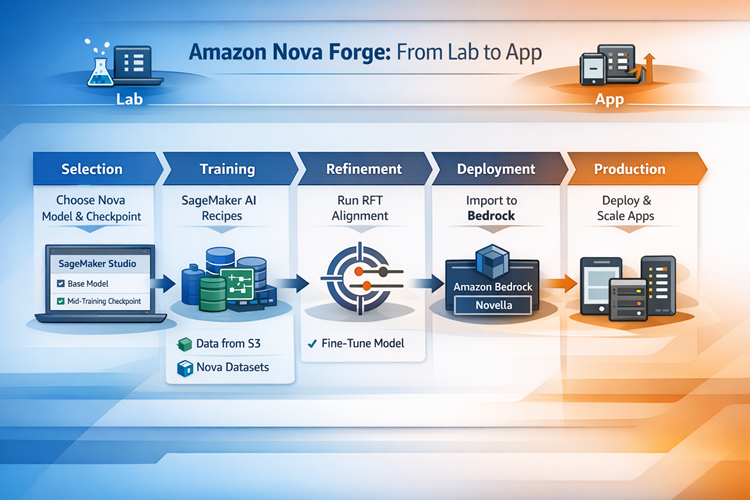
The Workflow: From Training to Production
The process bridges the gap between the "lab" (SageMaker) and the "app" (Bedrock).
- Selection: You choose a Nova base model and a specific checkpoint (e.g., a "Mid-training" checkpoint) in Amazon SageMaker Studio.
- Training (SageMaker AI): You use SageMaker Recipes—pre-configured training scripts—to blend your data from S3 with Nova’s datasets. The heavy lifting (compute) happens on SageMaker's managed infrastructure.
- Refinement: Optionally, you run RFT in SageMaker to align the model with specific business outcomes or safety guardrails.
- Deployment (Bedrock): Once the "Novella" is ready, you import it into Amazon Bedrock as a private model.
- Production: Your applications call the custom model via the standard Bedrock API, benefitting from Bedrock’s serverless scaling and security.
Below is a sample training workflow:
Data Privacy and Protection
The security model is the most critical part:
- Sovereignty: Your data stays in your S3 buckets and within your VPC boundaries.
- No Leakage: AWS explicitly states that customer data is not used to train the base Amazon Nova models. Your "Novella" is a private resource visible only to your AWS account.
- Encryption: Data is encrypted at rest via KMS (AWS-managed or Customer-managed keys) and in transit via TLS 1.2+.
- Governance: Access is controlled via standard IAM policies, and all training activity is logged in CloudTrail.
Pricing Model
Nova Forge carries a distinct cost structure that reflects its "frontier" status:
- Subscription Fee: Access to the Forge environment starts at approximately --$100,000 per year.
- Usage Costs: On top of the subscription, you pay for the SageMaker compute (GPUs) used during the training phase.
-
Comparison: Cheaper than Training from Scratch: Building a frontier model from zero costs millions in compute and months of R&D. Nova Forge provides the "shortcuts" to get the same result for a fraction of that.
- More Expensive than Basic Fine-Tuning: Standard fine-tuning on Bedrock is much cheaper (often just a few dollars per hour), but it cannot achieve the deep "domain-native" intelligence that Nova Forge provides.
Summary
Amazon Nova Forge marks a shift from generic AI to native intelligence, where models don't just reference your data—they are built from it. By using "Open Training," you can bake specialized knowledge into the model’s core at the pre-training or mid-training stages. This results in a private Novella that understands your specific industry as naturally as its base language.
Organizations managing high-value proprietary data should consider moving beyond treating that information as an external reference. If your workflows involve specialized terminology or regulated processes that standard LLMs struggle to master, shifting customization earlier in the training lifecycle is often more effective than basic fine-tuning.
Disclaimer: AI tools were used to research and edit this article. Graphics are created using AI.
Additional references
About the Author
Eyal Estrin is a cloud and information security architect and AWS Community Builder, with more than 25 years in the industry. He is the author of Cloud Security Handbook and Security for Cloud Native Applications.
The views expressed are his own.



Top comments (8)
Implenix helps companies modernize their sales process through AI outbound calling technology. Our AI voice agents conduct natural conversations and qualify prospects in real time. Businesses can automate lead engagement while maintaining a human-like interaction experience. We focus on narrow industries to ensure precision and efficiency. Our approach increases productivity while reducing manual workload.
The platform SolarMovies is often discussed in online communities where users share recommendations, talk about movies they have watched, and discover new titles through conversations with other viewers from around the world.
La página casino-jugabets.cl/jugabet-promoci... muestra las promociones activas de JugaBet en Chile, incluyendo el bono de bienvenida, giros gratis, cashback y ofertas por depósitos. Los jugadores pueden activar beneficios al registrarse o hacer recargas, con condiciones claras como requisitos de apuesta y plazos. Es la sección principal de bonos del casino.
Amazon Nova Forge sounds interesting because it goes beyond basic fine-tuning. Instead of just adjusting the final layer of a model, Open Training allows access to different checkpoints in the model’s development. That means companies can integrate their proprietary knowledge deeper into the model’s reasoning process, not just customize surface-level behavior. This approach can be useful for organizations that need highly specialized AI aligned with internal data and workflows.
In a similar way, just like businesses look for advanced AI customization instead of generic tools, shoppers also prefer specific solutions when searching locally — for example, finding an amazon return store near me to get better deals on returned or overstock products. Platforms that make it easier to locate relevant, specialized resources — whether AI environments or local return stores provide more practical value to users.
Trong các môi trường cần vệ sinh liên tục như nhà kho, xưởng sản xuất hay khu công cộng, việc sử dụng thiết bị làm sạch chuyên dụng giúp tối ưu thời gian và công sức đáng kể. Với hệ thống quét hút hiện đại, xe quét rác có khả năng làm sạch nhanh bụi bẩn, rác thải và các tạp chất trên nhiều loại bề mặt khác nhau. Thiết bị vận hành ổn định, tiết kiệm nhân công và góp phần duy trì không gian luôn sạch sẽ, tạo nên môi trường làm việc chuyên nghiệp và hiệu quả hơn.
APKChrome is an online platform that provides access to a wide range of Android APK files for apps and games. It allows users to download applications directly to their devices without relying solely on traditional app stores. APKChrome often features the latest versions of popular apps, along with update details and installation guides. The platform features a simple interface, making it easy to search for and find specific APK files. Users can explore categories such as gaming, productivity, and entertainment. APKChrome aims to offer convenient access, quick downloads, and helpful information for Android users worldwide. Click here for more information.
777E is an exciting online gaming platform that offers a variety of interactive and entertaining games. Players can enjoy slot-style games, card challenges, and other engaging digital activities designed to provide nonstop fun. The platform features a clean, user-friendly interface, fast load times, and smooth navigation, making it suitable for both beginners and experienced users. 777E also provides attractive bonuses, daily rewards, and promotional offers to enhance the gaming experience. With secure login systems and regular updates, it ensures a safe, reliable, and immersive environment across mobile and desktop devices for gaming enthusiasts.
Is online earning reliable or just hype?