

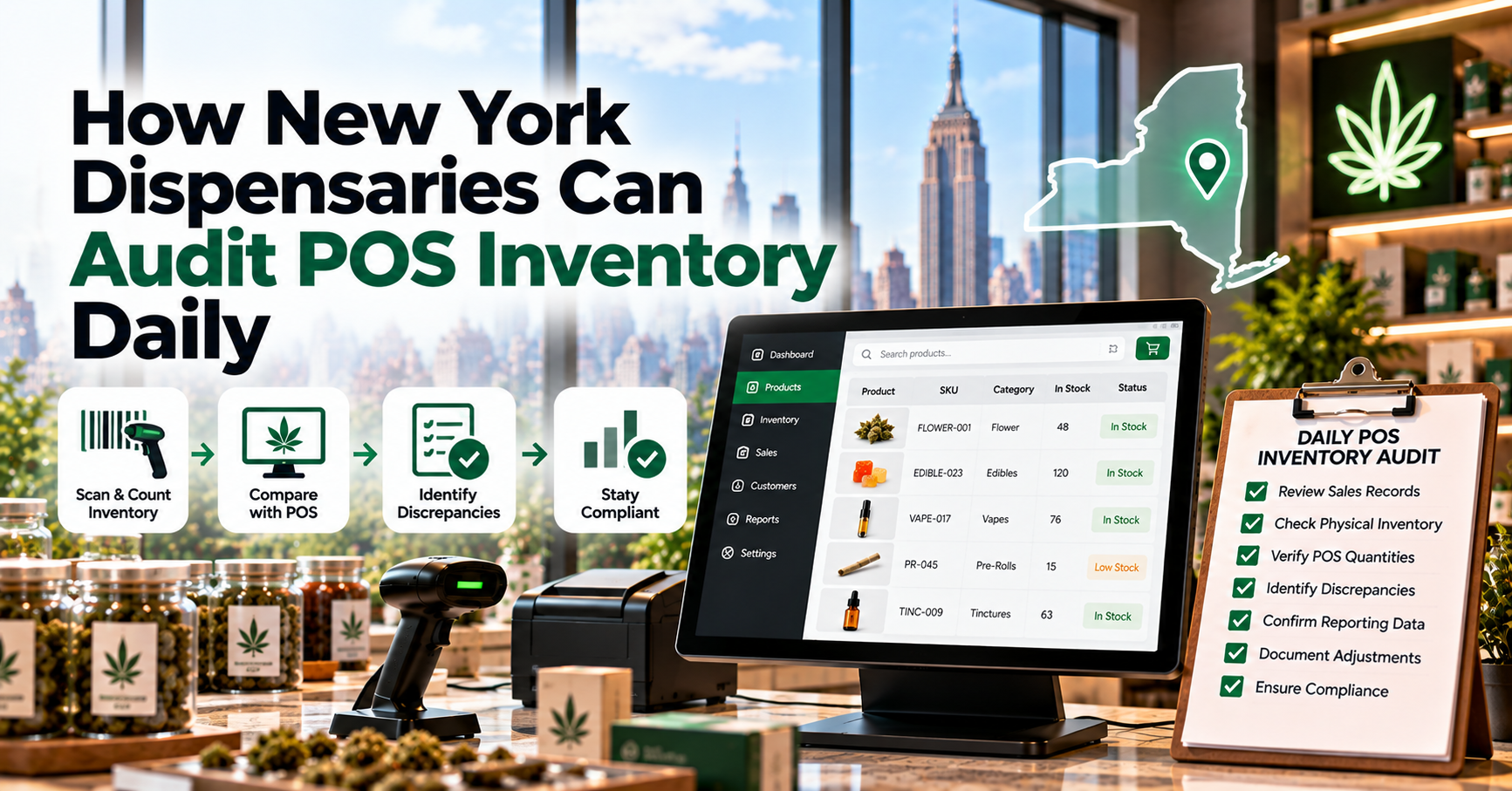
Accurate inventory management is essential for licensed cannabis dispensaries in New York. Every product received, sold, transferred, or adjusted affects a retailer's inventory records and regulatory responsibilities. Without regular checks, small discrepancies can accumulate, creating financial losses, reporting problems, and unnecessary compliance risks.
A reliable cbd point of sale New York solution can help retailers organize product information, monitor stock movements, and identify inconsistencies. However, licensed cannabis dispensaries need more than conventional CBD checkout features. Their systems must also support applicable product tracking, documentation, and regulatory reporting requirements.
Daily inventory auditing is not simply about counting products. It is about confirming that physical stock, POS records, and required tracking data accurately reflect the same business activity. This guide explains how New York cannabis retailers can establish an efficient daily audit process.
Why Daily POS Inventory Audits Matter
Reduce Compliance and Financial Risks
Cannabis retailers operate in a regulated environment where inventory accuracy is especially important.
Discrepancies can result from scanning mistakes, incorrect receiving quantities, unrecorded adjustments, or synchronization failures.
A daily audit helps managers detect these issues while relevant transactions and employee activities are still easy to investigate.
Benefits include:
- More accurate inventory records.
- Earlier identification of reporting errors.
- Reduced risk of overselling products.
- Better purchasing decisions.
- Improved employee accountability.
- More reliable financial reporting.
Finding an inventory problem today is usually easier than reconstructing its cause several weeks later.
Understand New York Tracking Requirements
New York cannabis retailers must follow requirements established by the state's Office of Cannabis Management (OCM).
The state's seed-to-sale tracking framework makes it important to maintain accurate records and verify applicable reporting workflows.
For official regulations and program updates, consult the New York State Office of Cannabis Management.
Daily internal audits support compliance, but they do not replace any formal inventory counts, reporting deadlines, or recordkeeping duties required by current rules.
Step 1: Establish a Consistent Audit Schedule
Choose the Right Time
Many dispensaries find it practical to review inventory near the end of the business day.
At that point, managers can compare recorded sales, receiving activity, and inventory adjustments against the day's physical stock movements.
However, the best schedule depends on staffing, store hours, and operational complexity.
Choose a consistent audit window and document who is responsible for completing it.
Assign Clear Responsibilities
A daily audit should involve employees with appropriate inventory and reporting permissions.
Consider assigning:
- An inventory specialist to review stock quantities.
- A shift manager to investigate transaction discrepancies.
- A compliance employee to review reporting exceptions.
- A designated supervisor to approve corrections.
Smaller dispensaries may combine these responsibilities, but review and approval controls should remain clear.
Inventory corrections should never depend on undocumented employee assumptions.
Step 2: Review Daily POS Transactions
Check Sales and Product Deductions
Start by reviewing completed transactions in your New York dispensary POS platform.
Confirm that products sold during the day were deducted from the correct inventory records.
Pay attention to package identifiers, product quantities, and transactions involving multiple items.
Look for unusual patterns, including:
- Duplicate transactions.
- Unexpected inventory deductions.
- Incorrect product selections.
- Reversed or voided sales.
- Unusual discount activity.
- Transactions requiring additional review.
Investigate exceptions before changing inventory balances.
Review Returns and Corrections
Returns and transaction corrections may require specific handling under applicable cannabis regulations.
Verify that each adjustment has an appropriate explanation and supporting documentation.
Do not automatically return regulated products to sellable inventory without confirming the applicable requirements and product status.
Step 3: Compare Physical Inventory With POS Records
Perform Targeted Physical Counts
A complete physical count of every product may not be practical each day.
Instead, dispensaries can use risk-based cycle counting alongside any inventory procedures required by New York regulations.
Prioritize products with:
- High sales volume.
- Frequent quantity discrepancies.
- Recent receiving activity.
- Complex package configurations.
- Previous reporting errors.
- Higher financial value.
Rotate product categories so inventory receives consistent attention over time.
Record Differences Accurately
Compare counted quantities against the POS system.
If a discrepancy appears, document the product, package identifier, expected quantity, physical quantity, and employee performing the count.
For example, if the POS shows 20 units but employees count 18, investigate the two-unit difference before making an adjustment.
A discrepancy is a signal to investigate, not an automatic instruction to change the system balance.
Step 4: Verify Seed-to-Sale Reporting
Check Tracking System Synchronization
New York seed-to-sale dispensary software may exchange information with the state's designated tracking infrastructure.
Where applicable, Metrc integration New York helps connect regulated inventory and transaction workflows.
Managers should verify whether required records have been successfully transmitted and accepted.
A completed sale in the POS does not necessarily mean the corresponding external reporting request succeeded.
Investigate Reporting Exceptions
Review the system for:
- Pending submissions.
- Rejected reporting requests.
- Invalid package identifiers.
- Quantity mismatches.
- Duplicate submission warnings.
- Integration connection failures.
If reporting status is uncertain, confirm the external record before retrying.
Repeatedly submitting the same transaction without checking its status can create additional reconciliation problems.
Document unresolved exceptions and assign responsibility for follow-up.
Step 5: Audit Receiving and Inventory Adjustments
Verify Newly Received Products
Receiving errors can affect inventory long before products reach the checkout counter.
Compare the day's received products against appropriate shipping documentation, package identifiers, and recorded quantities.
Check that inventory was assigned to the correct product records.
Any discrepancy should be investigated using approved receiving and reporting procedures.
Review Manual Adjustments
Manual inventory adjustments deserve particular attention because they change stock balances outside ordinary sales activity.
For every adjustment, confirm:
- The reason for the change.
- The affected product and package.
- The quantity involved.
- The employee responsible.
- The approval record, if required.
- The associated reporting status.
Restrict adjustment permissions to authorized employees.
Step 6: Monitor Online Menus and Connected Systems
Check eCommerce Inventory Accuracy
A cannabis ecommerce platform New York integration may display product availability based on POS inventory.
If synchronization is delayed, customers could see products that are no longer available.
Compare selected online menu quantities against verified store inventory.
Review canceled orders, reserved products, and incomplete transactions according to your platform's workflow.
Review Multi-Location Inventory
Businesses using multi location dispensary software New York should verify that inventory belongs to the correct licensed location.
Avoid treating products at separate locations as interchangeable stock.
Transfers and other inventory movements must follow applicable authorization, tracking, and documentation requirements.
Centralized visibility is useful, but each location still needs accurate records and appropriate controls.
Step 7: Investigate Common Inventory Discrepancies
Identify the Root Cause
When inventory records disagree, determine why before applying corrections.
Common causes include:
- Employees scanning the wrong product.
- Incorrect package assignments.
- Receiving quantities entered inaccurately.
- Duplicate or missing sales records.
- Delayed synchronization.
- Unauthorized inventory adjustments.
- Physical counting mistakes.
Review transaction histories, employee logs, and relevant reporting records.
Document Corrective Actions
Once the cause is established, follow the approved correction process.
Record the original discrepancy, supporting evidence, corrective action, and final verification.
If the issue affects regulatory reporting, address the reporting requirement through the appropriate workflow.
A useful audit trail explains both what changed and why the change was necessary.
Step 8: Use POS Reports to Simplify Audits
Choose Practical Inventory Reports
POS software for New York cannabis retailers should make essential inventory information easy to access.
Useful reports include:
- Beginning and ending inventory.
- Daily product sales.
- Receiving activity.
- Inventory adjustments.
- Package-level stock movements.
- Reporting exceptions.
- Employee transaction histories.
Managers should be able to filter records by date, product, package, and employee when supported.
Automate Alerts Where Possible
Some dispensary software in New York includes alerts for low inventory, unusual adjustments, or synchronization failures.
These notifications can help teams prioritize reviews.
However, automated alerts should complement physical checks and management oversight rather than replace them.
Daily Cannabis POS Inventory Audit Checklist
Use this checklist to standardize your store's daily review:
- [ ] Confirm the day's sales records are complete.
- [ ] Review voids, returns, and corrections.
- [ ] Count selected physical inventory.
- [ ] Investigate quantity discrepancies.
- [ ] Verify receiving records.
- [ ] Review manual inventory adjustments.
- [ ] Check regulatory reporting status.
- [ ] Confirm online inventory accuracy.
- [ ] Document unresolved issues.
- [ ] Obtain supervisor approval where required.
Keep completed checklists and supporting records according to your business's applicable retention requirements.
How to Improve Audit Efficiency Over Time
Track Recurring Problems
Daily audits become more valuable when managers analyze patterns rather than treating every discrepancy as an isolated event.
Monitor which products, shifts, or workflows generate repeated errors.
Recurring issues may indicate inadequate training, unclear procedures, or software configuration problems.
Improve Employee Training
Employees should understand how checkout activity affects inventory and regulatory records.
Provide practical training on barcode scanning, receiving procedures, transaction corrections, and discrepancy reporting.
Encourage employees to report mistakes promptly rather than attempting undocumented fixes.
A strong inventory process depends on reliable technology and employees who understand their responsibilities.
Final Thoughts
Daily POS inventory audits help New York cannabis dispensaries maintain accurate records, identify operational weaknesses, and reduce preventable reporting problems.
An effective process combines transaction reviews, targeted physical counts, receiving verification, reporting checks, and documented corrective actions.
The right cannabis retail platform for New York can make these tasks easier by providing clear inventory histories and useful exception reports.
The goal is not simply to make inventory numbers match. It is to establish a trustworthy record of how products move through the business.
With consistent procedures and regular employee training, dispensaries can strengthen inventory control while supporting responsible, compliant retail operations.



Top comments (0)