

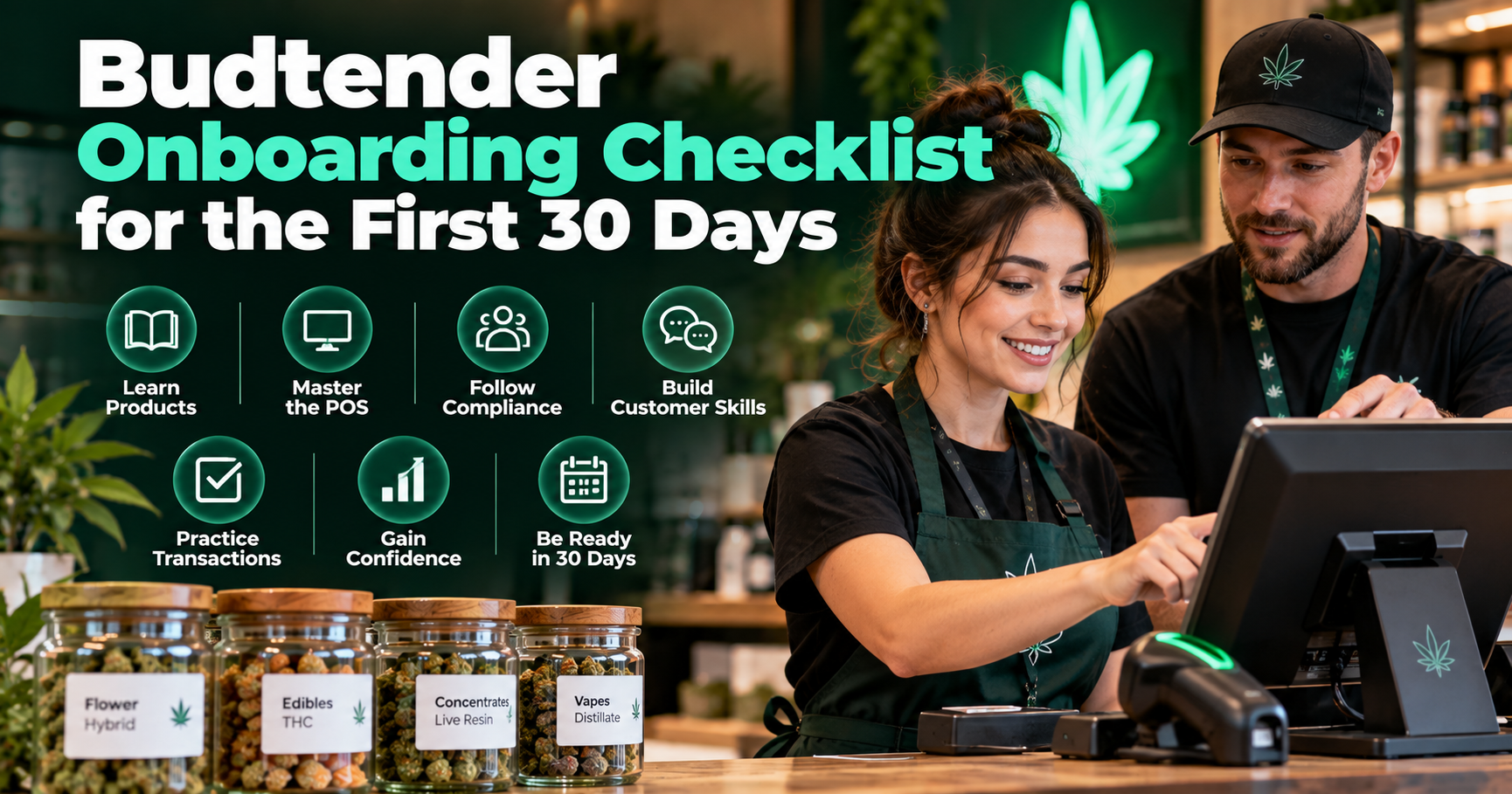
Hiring a new budtender is only the beginning of building a reliable dispensary team. New employees must learn cannabis product basics, customer service, point-of-sale (POS) procedures, and state-specific compliance requirements. Without a structured onboarding process, even motivated employees can develop habits that lead to checkout mistakes, inventory discrepancies, or inconsistent customer experiences.
Using reliable dispensary staff pos software can support the learning process by providing consistent checkout workflows and employee access controls. However, technology works best when combined with practical training, clear expectations, and regular feedback from experienced staff.
The first 30 days should focus on building accuracy and confidence before expecting speed or independent performance. This checklist gives dispensary managers a practical framework for training new budtenders.
Why a 30-Day Budtender Onboarding Plan Matters
The Cost of Inconsistent Training
Budtenders handle responsibilities that affect sales, customer satisfaction, inventory accuracy, and regulatory compliance.
When training depends entirely on whichever employee happens to be available, important procedures may be explained differently or overlooked.
A structured budtender onboarding program helps managers establish consistent expectations across the team.
It also makes progress easier to measure.
Set Clear Learning Goals
By the end of the first month, a new budtender should be able to:
- Explain basic cannabis product categories.
- Follow customer identification procedures.
- Navigate essential POS functions.
- Complete standard transactions accurately.
- Recognize purchase limit warnings.
- Handle common customer questions.
- Escalate unfamiliar situations appropriately.
Successful onboarding means demonstrating reliable skills, not simply completing 30 days of employment.
Week 1: Learn the Store, Products, and Compliance Rules
Days 1–2: Orientation and Store Procedures
Start with an introduction to daily dispensary operations.
Explain the store layout, employee responsibilities, security procedures, and expectations for customer interactions.
New employees should understand where products are stored, who approves sensitive transactions, and how to report operational problems.
Week 1 checklist:
- [ ] Review workplace policies and scheduling procedures.
- [ ] Learn store opening and closing responsibilities.
- [ ] Understand security and inventory access rules.
- [ ] Meet supervisors and assigned training partners.
- [ ] Review customer service expectations.
- [ ] Learn how to report incidents and discrepancies.
Assign an experienced employee to answer questions and demonstrate routine tasks.
Days 3–5: Cannabis Product Knowledge
Introduce the main product categories carried by the dispensary.
Cannabis product knowledge training for staff should cover:
- Flower and pre-rolls.
- Edibles and beverages.
- Concentrates and vape products.
- Tinctures and topicals.
- THC and CBD information.
- Product labels and serving sizes.
Include terpene and strain education for budtenders, while emphasizing that product effects vary between individuals.
Employees should avoid making unsupported medical claims or guaranteeing specific outcomes.
Compliance Training
Responsible cannabis sales training is essential from the beginning.
Review the requirements that apply to your store, including identification checks, customer eligibility, purchase limits, and transaction documentation.
The Cannabis Regulators Association (CANNRA) provides information about cannabis regulatory authorities. Managers should use their own state regulator's current guidance for specific legal requirements.
Never allow new employees to handle regulated transactions independently before completing required training and authorization.
Week 2: Practice POS Transactions and Customer Service
Days 6–8: Learn the POS Interface
Introduce the pos system for budtenders through demonstrations and supervised practice.
Employees should learn how to search for products, scan barcodes, build carts, and review transaction totals.
Week 2 POS checklist:
- [ ] Log in using assigned credentials.
- [ ] Locate products by name or barcode.
- [ ] Confirm product quantities and variants.
- [ ] Review applicable taxes and discounts.
- [ ] Recognize POS warnings.
- [ ] Understand approved payment procedures.
- [ ] Know when manager approval is required.
Use a training environment where available to avoid creating inaccurate live records.
Days 9–10: Supervised Checkout Practice
Allow new budtenders to complete standard transactions under direct supervision once they are eligible to do so.
Focus on correct procedures rather than transaction speed.
Common practice scenarios should include:
- A customer purchasing multiple products.
- A transaction approaching a purchase limit.
- An incorrect barcode scan.
- A customer asking about a promotion.
- An interrupted payment.
- A transaction requiring supervisor assistance.
Cannabis pos training for new employees should include both successful transactions and common mistakes.
Employees who understand how to recover from errors are better prepared than those who only memorize routine steps.
Customer Communication Skills
Customer service training for cannabis retail staff should teach employees to ask useful questions without pressuring customers.
Encourage clear explanations, respectful communication, and accurate product information.
Budtenders should know when to refer medical or legal questions to qualified professionals.
Week 3: Build Independence and Problem-Solving Skills
Days 11–15: Handle More Complex Situations
During the third week, employees can gradually take on additional responsibilities based on demonstrated competence.
Training should cover returns, transaction corrections, inventory questions, and difficult customer interactions.
Week 3 checklist:
- [ ] Explain current promotions accurately.
- [ ] Recognize incorrect product selections.
- [ ] Follow approved return procedures.
- [ ] Escalate inventory discrepancies.
- [ ] Handle common customer complaints professionally.
- [ ] Follow procedures during POS interruptions.
- [ ] Maintain accurate transaction records.
Managers should provide immediate feedback when employees make mistakes.
Practice Product Recommendations
Budtender upselling and cross-selling techniques should focus on customer needs rather than increasing transaction totals at any cost.
For example, employees may explain differences between product formats or help customers compare available options.
Recommendations should remain factual, respect customer preferences, and follow applicable regulations.
Evaluate Progress
Observe several transactions and assess:
- Checkout accuracy.
- Product identification.
- Customer communication.
- Compliance awareness.
- Ability to recognize mistakes.
- Appropriate use of supervisor assistance.
A confident employee is not necessarily a fully trained employee. Skills should be demonstrated through observation.
Week 4: Validate Skills and Prepare for Independent Work
Days 16–25: Strengthen Daily Performance
During the final training phase, employees should practice handling normal workloads while maintaining accuracy.
Managers can gradually reduce direct supervision where permitted.
A budtender friendly pos interface may make routine tasks easier, but employees still need to understand the procedures behind each action.
Review any recurring mistakes and provide targeted coaching.
Days 26–30: Complete a Skills Assessment
Before approving independent register access, conduct a structured evaluation.
Final onboarding checklist:
- [ ] Demonstrates accurate product selection.
- [ ] Follows identification and eligibility procedures.
- [ ] Understands applicable purchase limits.
- [ ] Processes standard payments correctly.
- [ ] Explains basic product categories.
- [ ] Handles routine customer questions.
- [ ] Recognizes when supervisor approval is needed.
- [ ] Follows inventory and security procedures.
- [ ] Understands transaction correction policies.
- [ ] Completes all required training documentation.
If an employee needs additional support, extend supervised training rather than approving access based only on time served.
Independent checkout privileges should be earned through demonstrated readiness.
How to Measure Budtender Onboarding Success
Track Training Performance
Dispensary staff performance tracking can help managers identify training gaps.
Useful onboarding metrics include:
- Training checklist completion.
- Transaction error frequency.
- Number of corrections requiring approval.
- Product knowledge assessment results.
- Compliance procedure adherence.
- Customer service observations.
Avoid using sales volume or checkout speed as the only measures of success.
New employees may need more time to complete transactions correctly.
Schedule Regular Feedback
Short check-ins help identify problems before they become habits.
A practical schedule includes:
- Day 7: Review basic knowledge and compliance understanding.
- Day 14: Evaluate supervised POS performance.
- Day 21: Discuss complex situations and customer interactions.
- Day 30: Complete the final assessment and development plan.
Document feedback and agree on specific improvement goals.
How IndicaOnline Can Support Budtender Training
Evaluate POS Usability
IndicaOnline for budtenders is one option for dispensaries evaluating checkout workflows and staff-facing software.
When reviewing IndicaOnline POS, request demonstrations of product searches, transaction processing, employee permissions, and relevant compliance workflows.
Ask what training resources are available and whether the platform supports supervised onboarding procedures.
Confirm current capabilities directly with the provider.
Match Software to Training Needs
An easy to use dispensary pos for staff should help employees find accurate product information, understand transaction warnings, and follow consistent checkout procedures.
However, even intuitive software requires clear store policies and regular practice.
The best training process combines usable technology with accountable, well-prepared employees.
Conclusion
A structured 30-day budtender onboarding checklist helps cannabis retailers introduce new employees to store procedures, product knowledge, compliance requirements, POS transactions, and customer service.
The first week should establish essential knowledge. The second should focus on supervised checkout practice. The third should develop problem-solving skills, while the fourth should confirm readiness for independent work.
By combining practical training, regular feedback, and clear performance standards, dispensaries can reduce avoidable mistakes and create a more consistent customer experience.
The goal of onboarding is not to produce the fastest budtender in 30 days. It is to develop a dependable employee who understands how to serve customers accurately, responsibly, and confidently.



Top comments (0)