

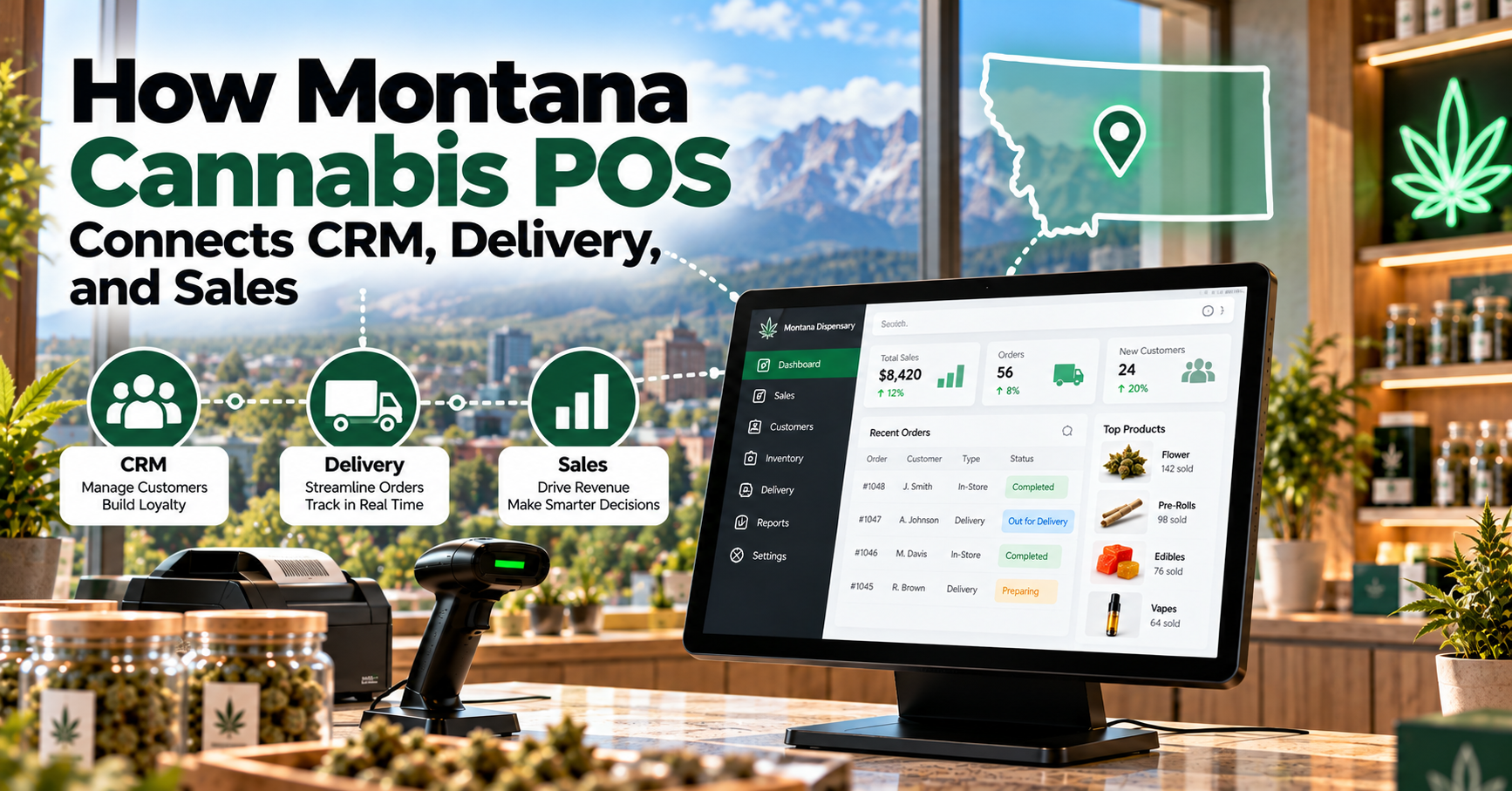
Running a successful cannabis dispensary in Montana requires more than processing transactions. Retailers must manage inventory, maintain accurate customer records, coordinate orders, and meet regulatory requirements. When these activities depend on disconnected software systems, employees may spend unnecessary time entering information manually, correcting mistakes, and checking inconsistent records.
A modern cannabis delivery software Montana solution may offer connections to point-of-sale, inventory, and customer management tools. However, dispensaries must distinguish between available technology and activities permitted under Montana law. Delivery-related features should only be considered for workflows authorized under current licensing and regulatory requirements.
The real value of an integrated cannabis POS system is having reliable information move between business functions without unnecessary duplication. This article explains how Montana dispensaries can connect CRM, order management, inventory, and sales reporting while maintaining appropriate compliance controls.
Why Integrated Cannabis Retail Software Matters
The Problem With Disconnected Systems
Many dispensaries use separate applications for checkout, customer management, online menus, and financial reporting.
When these tools do not communicate effectively, employees may encounter:
- Inconsistent product availability.
- Duplicate customer records.
- Delayed order updates.
- Manual data entry mistakes.
- Inaccurate sales reports.
- Difficulty reconciling inventory.
- Limited visibility into business performance.
These problems become more complicated as transaction volumes increase.
A connected Montana dispensary POS platform can reduce administrative work by organizing essential retail information within compatible workflows.
Understanding Montana Compliance Requirements
Montana cannabis businesses operate under rules administered by the state's Cannabis Control Division.
Licensed retailers must follow applicable requirements for inventory tracking, transactions, product handling, and recordkeeping.
Montana uses Metrc for regulated seed-to-sale tracking, making accurate inventory and reporting processes especially important.
For current guidance, consult the Montana Cannabis Control Division.
Software integration supports compliance, but it does not replace the retailer's responsibility to follow state regulations.
1. How Cannabis POS Connects Sales and Inventory
Real-Time Inventory Updates
A point-of-sale system records retail transactions and updates associated inventory information.
When configured correctly, the platform can help employees identify available products and maintain consistent stock records.
For example, a completed sale may trigger an inventory deduction in the POS and initiate the appropriate reporting workflow.
This reduces the need to update multiple databases manually.
However, retailers should verify whether external tracking systems have accepted required reports.
Better Product Visibility
POS software for Montana cannabis retailers may organize information such as:
- Product names and categories.
- Package identifiers.
- Available quantities.
- Retail prices.
- Inventory adjustments.
- Transaction histories.
- Reporting status.
Employees can use this information to answer customer questions and reduce checkout errors.
Accurate product information is the foundation of every other retail integration.
If inventory records are incorrect, connected online menus and order management tools may display unreliable information.
2. Connecting CRM With Dispensary Sales
Building a More Organized Customer Experience
Customer relationship management software helps businesses organize customer information and permitted communications.
When cannabis CRM Montana tools connect with the POS, retailers may gain a clearer understanding of purchasing patterns and customer service needs.
Depending on the platform, integrated features may include:
- Customer profile management.
- Purchase history visibility.
- Loyalty program administration.
- Customer segmentation.
- Permitted promotional communications.
- Customer service notes.
These capabilities should be configured according to applicable privacy and cannabis marketing requirements.
Using Customer Data Responsibly
Customer information should only be collected and used for legitimate, authorized business purposes.
Retailers should establish clear access permissions and protect sensitive records.
Ask software providers how they manage customer consent, data storage, and third-party integrations.
A useful CRM system should improve customer service without creating unnecessary privacy risks.
3. How POS Connects Online Ordering
Keeping Product Menus Accurate
Online menus allow customers to explore available products before visiting a dispensary.
A cannabis ecommerce platform Montana integration may connect menu information with the store's POS inventory.
When products sell in-store, the online menu can reflect updated availability according to the integration's synchronization capabilities.
This helps reduce situations where customers attempt to reserve unavailable products.
Managing Orders Across Channels
Connected order management tools can help employees monitor order status and coordinate permitted fulfillment workflows.
Useful capabilities may include:
- Centralized order notifications.
- Product availability checks.
- Order status updates.
- Inventory reservation controls.
- Customer pickup instructions.
- Transaction history synchronization.
Before enabling any ordering feature, verify that the workflow complies with Montana's current cannabis regulations.
An online order should not bypass required verification, checkout, or reporting procedures.
4. Understanding Delivery Software Integration
What Delivery Tools Can Do
Delivery management software may include route planning, order assignment, dispatch dashboards, and delivery status tracking.
These features can be useful in industries where delivery is legally authorized.
However, Montana cannabis retailers should not assume that cannabis delivery is permitted merely because a vendor advertises delivery functionality.
Confirm current state requirements before purchasing or activating these features.
Evaluating Delivery-Related Integrations
If a particular workflow is legally authorized for the business, ask how the software connects operational information.
Potential integration capabilities include:
- Order details and status updates.
- Product availability.
- Customer communication records.
- Employee task assignments.
- Transaction documentation.
- Inventory reconciliation.
The appropriate configuration depends on the retailer's license and applicable rules.
Regulatory authorization must come before software implementation, not after it.
5. Connecting POS With Metrc Reporting
Supporting Seed-to-Sale Tracking
Montana seed-to-sale dispensary software helps retailers maintain records associated with regulated cannabis products.
Metrc integration Montana allows supported systems to exchange relevant tracking information through approved technical connections.
A POS may assist with transaction reporting, package identification, and inventory reconciliation.
However, the exact integration capabilities depend on the provider and system configuration.
Monitoring Synchronization Errors
Managers should regularly review reporting status rather than assuming all transactions synchronize automatically.
Important checks include:
- Pending submissions.
- Rejected transactions.
- Package identifier mismatches.
- Inventory quantity discrepancies.
- Connection failures.
- Duplicate reporting warnings.
A completed POS transaction does not necessarily confirm successful reporting to an external system.
Reliable integration includes clear error visibility and documented recovery procedures.
6. Combining Sales Data With Business Analytics
Understanding Store Performance
When checkout, inventory, and customer management tools share consistent data, managers can analyze business performance more effectively.
A cannabis retail platform for Montana may provide reports covering:
- Daily and weekly revenue.
- Best-selling product categories.
- Inventory turnover.
- Average transaction value.
- Promotional performance.
- Employee sales activity.
- Product availability trends.
These insights can help dispensaries improve purchasing and staffing decisions.
Avoiding Misleading Reports
Integrated reports are only as accurate as the underlying records.
Duplicate transactions, incorrect product mappings, and synchronization delays can distort results.
Managers should periodically reconcile sales and inventory information before relying on dashboards for important decisions.
7. Choosing a Montana Cannabis POS With Strong Integrations
Evaluate Compatibility Before Purchasing
Not every POS provider supports the same external applications.
When comparing dispensary software in Montana, ask vendors which integrations are native, which require third-party services, and which involve additional fees.
Request demonstrations of the workflows your store actually needs.
Important questions include:
- Does inventory synchronize automatically?
- How frequently are connected records updated?
- What happens when internet access fails?
- Can employees identify synchronization errors?
- Are customer records protected appropriately?
- Can historical business data be exported?
- What technical support is available?
Choose integrations based on operational requirements rather than the total number of advertised features.
Consider Future Growth
Retailers planning additional locations should examine how the platform supports expansion.
Multi location dispensary software Montana may provide centralized reporting, location-specific inventory views, and standardized employee permissions.
However, each licensed location must maintain appropriate records and follow applicable tracking requirements.
Confirm how costs and integration capabilities change as the business grows.
8. Best Practices for Implementing Connected Systems
Start With Accurate Data
Before connecting new applications, review existing inventory, product catalogs, and customer records.
Remove unnecessary duplicates and investigate unresolved discrepancies.
Incorrect source data can spread quickly across connected platforms.
Test Each Integration Separately
Use vendor-approved testing environments whenever possible.
Verify product updates, order notifications, reporting status, and access permissions before launching new workflows.
Avoid testing regulated transactions through unauthorized live activity.
Train Employees and Monitor Results
Employees should understand how information moves between the POS and connected systems.
Provide clear procedures for:
- Processing transactions.
- Reviewing online orders.
- Updating customer information.
- Investigating inventory discrepancies.
- Identifying reporting errors.
- Escalating technical problems.
Review integration performance regularly and document recurring issues.
Montana Cannabis POS Integration Checklist
Before implementing a connected retail platform, confirm that:
- [ ] Current Montana requirements have been reviewed.
- [ ] Product and inventory records are accurate.
- [ ] POS and CRM data connections are documented.
- [ ] Customer information is appropriately protected.
- [ ] Online ordering workflows have been verified.
- [ ] Delivery-related features are legally applicable.
- [ ] Metrc reporting procedures have been tested.
- [ ] Synchronization errors are visible to managers.
- [ ] Employees understand connected workflows.
- [ ] Technical support and recovery procedures are established.
Final Thoughts
Connecting CRM, order management, inventory, and sales tools can help Montana dispensaries reduce administrative work and improve operational visibility.
A well-integrated Montana cannabis POS system allows employees to access consistent information while supporting more efficient daily workflows.
However, successful integration requires accurate records, responsible data management, and careful attention to regulatory requirements.
Retailers should prioritize dependable inventory synchronization, practical customer management features, transparent reporting, and vendor support.
By choosing technology that matches their actual business needs, Montana cannabis stores can build a more organized retail operation without compromising compliance or customer trust.



Top comments (0)