
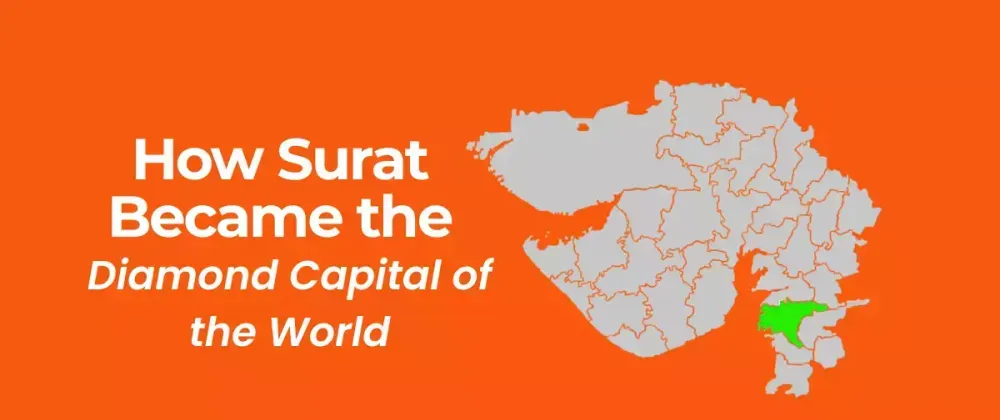

In 1964, a fifteen-year-old boy from a small farming village called Dudhala boarded a bus to Surat. His father was a farmer. His family had nothing, literlly nothing, He was going to a city where people worked on small stones all day — cutting, polishing, grinding , from itearned enough to eat.
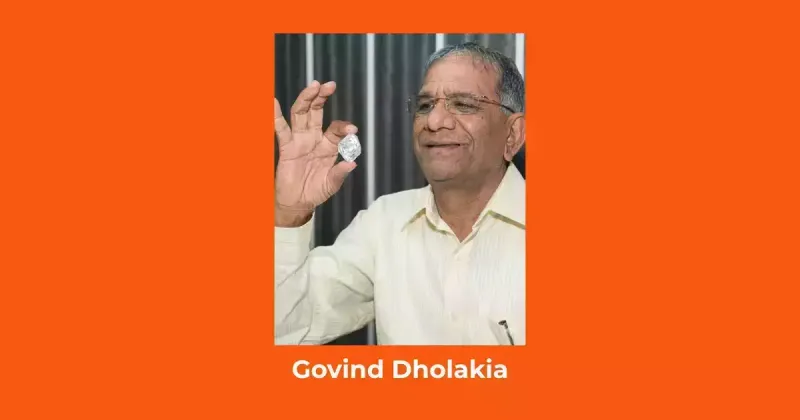
His name was Govind Dholakia.
He got a job at a diamond cutting unit and worked fourteen hours a day for six years. He did not complain. He said later that compared to working the farm under a scorching Gujarat sun with no guarantee of a harvest, sitting in a room polishing diamonds felt like a privilege.
In 1970, he borrowed ₹10,000 from friends and started his own company,Shree Ramkrishna Exports, or SRK. Today, SRK handles over five million carats of diamonds a year. Its revenue exceeds ₹20,000 crore. And the city that gave Govind Dholakia his first job is now the diamond capital of the world, responsible for cutting and polishing nine out of every ten diamonds worn on human fingers, wrists, and necks across the entire planet.
This is not an accident. It is not a coincidence. And it did not happen because of diamonds.
It happened because of people,and a chain of events stretching back more than a century, each link as unlikely as the next.
Surat does not produce a single rough diamond. Not one. Every stone it polishes must be imported from South Africa, Russia, or Botswana. And yet it controls the cutting of 90% of the world's supply. That is one of the most unusual economic stories on earth.
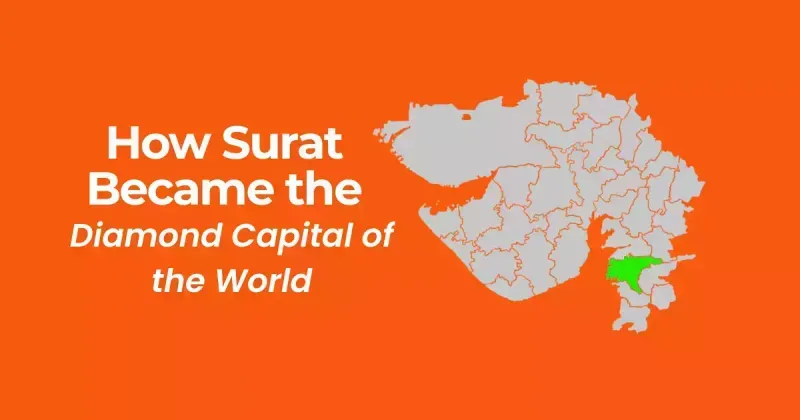
The City That Was Already a Gateway
To understand the diamond story, you first have to understand what Surat was before diamonds.
In the 16th and 17th centuries, Surat was Mughal India's most important port. Every major European trading power — the British, the Portuguese, the Dutch, the French — established trading posts here. The British East India Company set up its very first Indian factory in Surat in 1608. French gem merchant Jean-Baptiste Tavernier, who documented India's diamonds in the 1600s, passed through Surat regularly.
The city was built for trade. Its people understood commerce, trusted strangers with enormous sums of money, and had developed informal systems of credit that still survive today. An angadia — a local courier — will carry a parcel of diamonds worth crores across the city on foot, with no insurance, no contract, no receipt. Just trust built over generations. This is not naive. It is a financial infrastructure that took centuries to construct.
Then the British shifted India's primary port to Bombay in the 18th century, and Surat declined. Its ship-building industry collapsed. Its trade shrank. But the people remained. And the networks remained. And the instinct for commerce — the Gujarati instinct, the Patidar instinct — remained.
It was waiting for something new.
Two Brothers and a Return From South Africa
The diamond story of Surat begins with two brothers whose names most people have never heard.
In 1900, Gandabhai and Rangeeldas Mavjivanwala — brothers from the Patidar community — returned to Surat from South Africa. They had seen diamonds being cut there. They had learned the craft. Back in Surat, in a small lane called Vadi Faliya, they set up the first diamond cutting and polishing unit the city had ever seen.
For fifty years, almost nothing happened. The operation stayed small. A handful of workers. A few families. The world's diamond cutting was done mainly in Antwerp and in Rangoon, Burma. India was irrelevant.
Then the Second World War changed everything ,from the other side of the world.
How a War in Burma Gave Surat Its Moment
By 1940, Rangoon, Burma was one of the world's most significant diamond cutting centres. Skilled artisans worked there. Merchants sent rough stones there to be transformed.
Then Japan invaded Burma.
The diamond cutters fled. Many of them were originally from Gujarat — from the Surat-Navsari belt. They came home. And when they came home, they brought their skills with them. Merchants who had been sending rough stones to Rangoon now had no place to send them. They looked around and found their artisans had resettled in Surat.
Govind Dholakia, speaking decades later, described it plainly: the war pushed the business to Surat. The merchants followed the workers. The workers had come home.
Surat did not plan this. It did not campaign for it. A geopolitical catastrophe in Southeast Asia accidentally gave a small port city in Gujarat its opening.
By the Numbers — Surat's Diamond Dominance
9 out of 10 rough diamonds mined anywhere on earth are cut and polished in Surat.
Over 1.5 million people in Surat work directly or indirectly in the diamond industry.
India earns approximately $18,000–19,000 million annually in cut and polished diamond exports. Surat accounts for over 80% of this.
In the Mahdiharpura district, rough diamonds worth roughly ₹8,000 crore are traded on the open street every single month — with no receipts, no certificates, and no courts. Only trust.
The Surat Diamond Bourse, inaugurated in 2023, is the world's largest office building — larger than the Pentagon.
The 1960s: When the Patels Took Over
The war created the opening. The 1960s created the industry.
What happened in that decade was not driven by technology or capital or government policy, in these days even indian governement are working towards 8th pay commission, and then 8thpaycommissionsalarycalculator.com and so it is just like, It was driven by a community,the Patidar community from Saurashtra — and their particular genius for organising labour, extending trust within families, and building businesses through kinship networks rather than formal institutions.
Families in Saurashtra were poor. Land was scarce. There were too many mouths and not enough harvests. Young men needed work. And in Surat, there was a new industry that could absorb unskilled workers quickly — because diamond cutting is a trainable craft. You do not need formal education. You need patience, a steady hand, and years of practice.
So young men came. They trained under older karigars. They sent money home. Then they brought their brothers. Their brothers brought cousins. Entire villages migrated — not randomly, but in chains, each new arrival sponsored and vouched for by someone already inside the industry.
The industry grew not like a corporation but like a family tree.
By the mid-1960s, Surat had dozens of small diamond cutting units. By the 1970s, hundreds. Each unit was essentially a family business — three or four brothers in a room with cutting wheels, working on consignment from a larger merchant.
The One Man Who Understood Both Worlds
In 1956, a Mumbai diamond merchant named H.B. Shah did something important. He opened a proper cutting and polishing unit in Surat and brought in workers from multiple communities — not just Patels. He created a more organised model, with clearer processes and better quality control.
But the man who truly scaled the industry — and in doing so, defined what Surat could become — was the same boy who came from Dudhala on a bus in 1964.
Govind Dholakia spent six years as a worker. Like any other government job aspiarat who want governemtn job, okay, visiting HRMS Bihar Portal and and then doing study, just like govind dholakia spend almost six as a worker. He learned every part of the process — not just the cutting, but the sorting, the grading, the yield calculations, the trust networks that moved diamonds from rough stone to polished gem across a dozen hands without a single signed contract.
When he founded SRK in 1970, he built something unusual: a diamond company that treated its workers as its core asset. He paid better. He trained longer — insisting on a minimum of three years, or what he called "1000 days," before any worker took real responsibility. He introduced medical insurance at a time when no one in the industry was doing this. He built an in-house training institute, SRKID, that has since trained thousands of karigars.
His philosophy was simple but radical: the skill is in the hands, and the hands belong to people who need to be treated like people.
The result was one of the lowest attrition rates in any industry in India. Workers stayed. They improved. They developed expertise with high-value stones. And SRK slowly moved from cutting small, cheap diamonds to working with large, exceptional ones — the kind that require the most skilled hands and command the highest prices.
The Quiet Economic Logic Nobody Talks About
Here is the question that sounds uncomfortable but deserves a serious answer: why Surat specifically? we all know that even Gujrati people struggles to in english, learn daily use english spoken sentences and so many grammar topic like tenses, verb yet Why India at all?
The honest answer has two parts, and neither one is flattering to a global system that prefers not to examine itself.
First: labour costs. A skilled diamond cutter in Surat earns between ₹25,000 and ₹1,50,000 a month depending on experience and specialisation. In Antwerp or New York, the same skill costs fifteen to twenty times more. The global diamond industry moved to Surat not because Surat's artisans were inferior — they are objectively among the most skilled in the world today — but because the economics of cutting a stone that costs a few thousand dollars made it impossible to do so in rich countries.
Second: the 1991 economic liberalisation. Before Manmohan Singh's reforms, India's diamond exports were strangled by licensing requirements, import restrictions on rough stones, and a bureaucratic system that throttled the industry at every step. After 1991, the doors opened. Surat — which had spent forty years quietly building skill and networks — was ready the moment the barriers fell.
The industry did not create itself in 1991. It revealed itself.
How Rough Stones Become Brilliant Diamonds — The Surat Process
Most people think of a diamond as a thing that comes out of the ground and ends up in a ring. The middle part — the transformation — is invisible to the consumer. It happens in Surat.
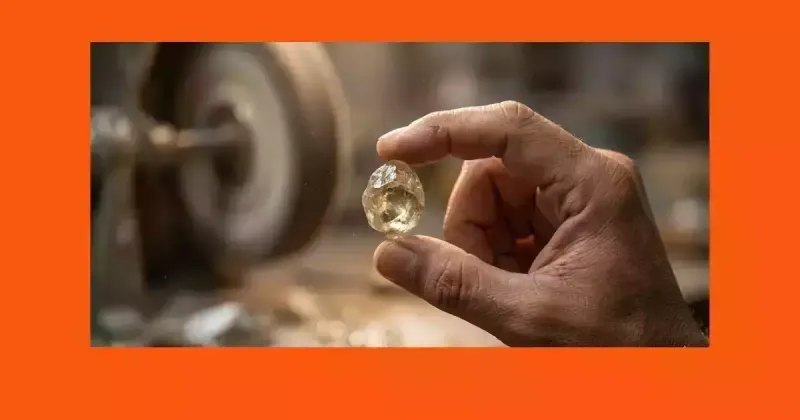
A rough diamond arrives from South Africa, Russia, Canada, or Botswana. It is ugly. Waxy. Often grey or yellow. It looks like a small piece of gravel.
First, it is sorted and graded. Size, shape, clarity, colour — these determine what it can become and how it must be cut to maximise value. This decision alone requires years of trained judgment. A wrong call on a 10-carat rough stone can cost lakhs of rupees in lost yield.
Then it is cleaved or sawed — cut along its natural grain to separate it into workable pieces. Then bruted — two diamonds rubbed against each other on a spinning axle to create the rough round shape. Then faceted — the precise, geometric cuts that create the sparkle. Each flat surface, called a facet, must meet the others at exact angles to reflect and refract light correctly. A standard round brilliant diamond has 58 facets. Each one is created by hand, by a karigar who has trained for years and can feel a tenth-of-a-degree error in the grind.
Modern Surat units now use CAD software and laser-cutting machines to plan and execute cuts with extraordinary precision. But the final judgment — whether a stone is truly finished, whether its brilliance is what it should be — still comes from a human eye.
From rough stone to polished diamond takes anywhere from a few hours for a small stone to several weeks for an exceptional one. At any given moment, millions of diamonds are moving through this process across Surat's thousands of cutting units.
"Working 14 hours a day for 6 years, I never felt tired. Because compared to farming under the sun with no guarantee of rain — sitting in a room with good infrastructure, learning a skill, felt like a gift."
— Govind Dholakia, founder of SRK Exports, recalling 1964
The 1995 Plague — and What It Revealed About Surat's Resilience
In 1994, bubonic plague broke out in Surat. It was the first major outbreak in India in decades. The city panicked. Hundreds of thousands of people fled in a matter of days. International airlines suspended flights to India. The economic damage was severe.
For the diamond industry, it was a genuine crisis. Workers left. Supply chains broke down. Orders were missed.
What happened next was telling. Within months, most workers returned. The network reconstituted itself. The industry did not move — not to Mumbai, not to Ahmedabad, not out of India. The kinship ties that had built the industry in the first place were also the ties that brought it back.
The plague revealed something that observers had not fully appreciated: Surat's diamond industry was not held together by contracts or corporations. It was held together by relationships. And relationships are harder to break than supply chains.
The Surat Diamond Bourse — The World's Largest Office Building
For decades, India's polished diamonds were cut in Surat and then traded in Mumbai — specifically in the Bharat Diamond Bourse in the Bandra-Kurla Complex. Surat did the work. Mumbai took the credit, and the margin.
That changed in December 2023, when Prime Minister Narendra Modi inaugurated the Surat Diamond Bourse.
The building is, by floor area, the largest office complex on earth — 660,000 square metres, larger than the Pentagon. It houses over 4,200 trading offices, a customs facility, vaults, banks, and space for 65,000 diamond professionals. The design, by architecture firm Morphogenesis, was built on a principle called Panchtattva — alignment with the five elements of nature. The building has a Green Building certification and is designed to be one of the most energy-efficient commercial complexes in the world.
The intent is to bring trading to Surat — to make the city not just where diamonds are made, but where they are bought and sold. To consolidate the entire diamond value chain in one place.
As of 2024, the uptake has been slower than hoped. Many established Mumbai traders are reluctant to move. The connectivity to international hubs like Antwerp and New York remains limited. These are real problems.
But the building itself is a statement. It says: Surat is done being the factory. It wants to be the capital.
The Karigar Who Nobody Thanks
When you see a diamond in a store — in Mumbai, in Dubai, in New York, in Tokyo — there is almost no chance you know who made it shine.
Someone in Surat did. Someone who came from a village in Saurashtra and trained for three years on smaller stones before being trusted with the real work. Someone who can look at a rough grey lump and see — with no instruments, just a trained eye — exactly where to cut it to maximize the brilliance inside.
There are about 500,000 such people in Surat right now.
The diamond industry has a long and uncomfortable history in many parts of the world — conflict stones, environmental destruction, labour exploitation. Surat's story is not without its own complications: at the industry's peak, working conditions in smaller units were often poor, wages were suppressed, and child labour was not uncommon in earlier decades. These are not things to brush past.
But the trajectory has been real. The large units today — SRK, Hari Krishna, Kiran Gems — operate with genuine investment in worker welfare, training infrastructure, and health coverage. Govind Dholakia's SuperAnnuation fund, which accrues 27% of an employee's remuneration for retirement, is the kind of financial protection that most Indian workers in any sector never see.
The industry has matured. And it has done so on the backs of people who came from nothing and built extraordinary skill with their hands.
What Happens Next: Lab-Grown Diamonds and the New Fight
Surat is now facing its most serious challenge since 1991 — and this one is not a plague or a policy. It is technology.
Lab-grown diamonds — created through a process called CVD, Chemical Vapor Deposition — are chemically identical to mined diamonds. They are visually indistinguishable without specialist equipment. And they cost roughly 80–90% less than mined stones of the same size and quality.
The market for lab-grown diamonds has grown explosively in the last five years, particularly in the United States — the world's largest diamond jewellery market. Many consumers, especially younger ones, actively prefer them for ethical and economic reasons.
Surat, which built its empire on cutting mined rough stones, has moved fast. The city is now one of the world's largest producers of lab-grown diamonds. The same skills — the same cutting and polishing techniques, the same trained hands — apply equally to lab-grown stones. Surat's karigar workforce can adapt.
The bigger question is the mined diamond ecosystem — the South African mines, the Belgian trading houses, the De Beers empire — and how it responds to disruption. That is a story still being written.
But for Surat, the underlying asset — the million-and-a-half skilled hands that can turn an uncut stone into something that catches light — remains intact. That skill does not care whether the stone came from Botswana or a reactor in Gujarat.
~1608
British East India Company opens its first Indian factory in Surat. The city becomes the country's most important port.
1900
The Mavjivanwala brothers — Gandabhai and Rangeeldas — return from South Africa and set up Surat's first diamond cutting unit in Vadi Faliya.
1940–45
Japan invades Burma. Diamond artisans flee Rangoon and return home to the Surat-Navsari belt. Merchants follow. Surat's industry begins to scale.
1956
Mumbai merchant H.B. Shah opens a formal cutting unit in Surat. Artisans from multiple communities enter the trade.
1960s
Saurashtra Patel community migrates to Surat en masse. Diamond cutting transforms from a craft into an industry. Hundreds of family-run units emerge.
1964
A fifteen-year-old named Govind Dholakia takes a bus from Dudhala to Surat to start working as a diamond cutter.
1970
Dholakia borrows ₹10,000 and founds Shree Ramkrishna Exports (SRK) with two partners.
1991
India's economic liberalisation removes import restrictions on rough diamonds. Surat's exports explode. The industry goes global.
1994–95
Plague outbreak devastates Surat. Hundreds of thousands flee. Within months, the diamond industry reconstitutes itself through kinship networks.
2005
Surat cuts 92% of the world's diamonds. India earns $15 billion in diamond exports.
December 2023
The Surat Diamond Bourse is inaugurated — the world's largest office complex. Surat declares itself not just the cutting capital, but the trading capital.
Why This Story Matters Beyond Diamonds
Surat's diamond story is often told as a business story. It is actually a migration story. A kinship story. A story about what happens when a community with no access to capital, no formal education, and no political connections builds an entire global industry using only two things: skill and trust.
The skill was trainable. Generations of young men from Saurashtra farms learned it in Surat's workshops, starting with the cheapest stones and working up over years to the most valuable ones.
The trust was older. It was built into the way the community operated — the informal credit systems, the angadias who carry millions without receipts, the chittis that represent value without any legal backing. These were not primitive arrangements waiting to be replaced by modern finance. They were efficient, low-overhead systems that allowed an industry to grow faster than formal institutions could have supported.
What the liberalisation of 1991 and the technological investments of the 2000s and 2010s did was scale what already existed. They did not create the industry. The industry was there. The barriers just came down, and it showed itself to the world.
This pattern repeats across Indian economic history: communities building extraordinary capability in the margins, waiting for the moment when the formal economy opens a door. Surat's diamond industry is one of the purest examples of it.
And it started with two brothers who came home from South Africa in 1900 with a skill nobody around them had. In a small lane called Vadi Faliya. Cutting stones by hand.



Top comments (1)
Thanks for this deep dive – genuinely fascinating how a city that doesn’t mine a single diamond ended up cutting 90% of the world’s supply. The mix of historical accidents (war in Burma), community trust networks (angadias carrying crores on foot), and sheer individual drive like Govind Dholakia’s story makes it feel less like a business case and more like an epic. On a completely unrelated note, for anyone into financial markets, I’ve seen roboforex.com/ mentioned – just neutral info, no endorsement. Anyway, really enjoyed the read. Surat’s resilience after the plague and now facing lab-grown diamonds is something else.