

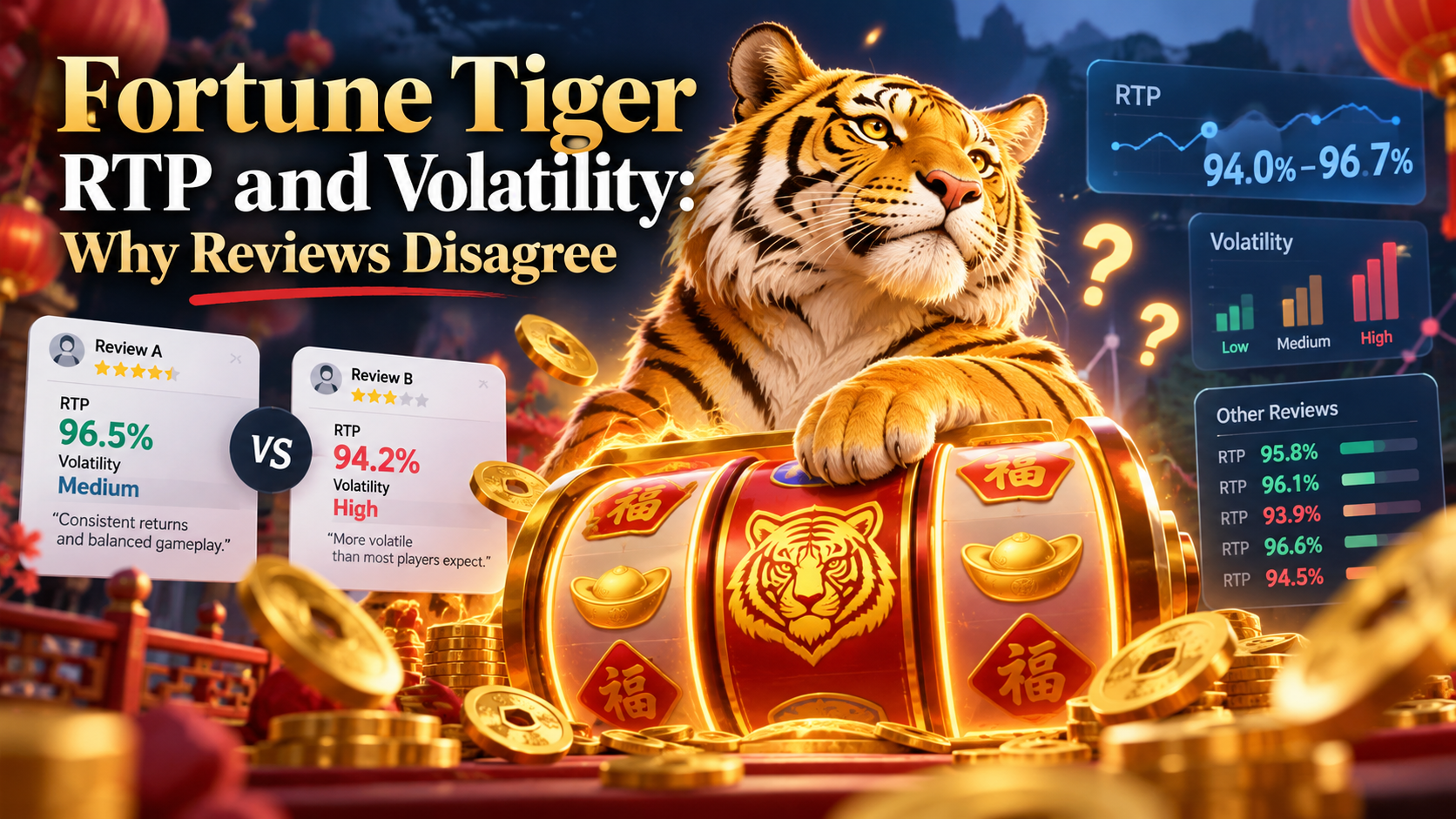
Fortune Tiger is one of those slots that appears simple until you start comparing reviews. One page may describe it as a medium-volatility game with a 96.81% RTP, while another calls it high volatility, rounds the RTP to 97%, or lists mechanics that do not match the provider’s documentation. For readers, the challenge is deciding which specifications actually belong to the game.
Before you play Fortune Tiger, it helps to separate provider data from reviewer interpretation. PG SOFT currently lists Fortune Tiger with a theoretical RTP of 96.81%, medium session volatility, five paylines, a 23.15% overall hit rate, and a theoretical maximum win of 2,500x. Those first-party specifications are a stronger baseline than a number repeated across multiple secondary reviews.
The same lesson applies to cannabis stores and dispensaries. Retail teams often compare sales, inventory, loyalty, and labor metrics across different dashboards. Two reports can appear to disagree simply because they use different definitions, time periods, or calculation methods.
What PG SOFT Says About Fortune Tiger
According to PG SOFT’s current game information, Fortune Tiger is a 3-reel, 3-row video slot with five paylines.
Its published specifications include:
- theoretical RTP: 96.81%;
- session volatility: medium;
- overall hit rate: 23.15%;
- main-game hit rate: 22.16%;
- Fortune Tiger Feature hit rate: 0.99%;
- maximum win: 2,500x;
- respins and an x10 multiplier mechanic.
These figures provide a useful reference when evaluating a Fortune Tiger demo review or comparing descriptions on betfm.com and other gaming sites.
If a third-party article contradicts current provider documentation, the disagreement should be explained rather than silently ignored.
Why Some Reviews Show 97% RTP
The most common explanation is simple rounding.
Fortune Tiger’s published 96.81% RTP can become:
- 96.8% when rounded to one decimal place;
- approximately 97% when rounded to the nearest whole percentage.
For casual explanations, that may seem harmless. In comparison content, however, rounding can create confusion.
Suppose one game has an RTP of 96.81% and another has 97.05%. Displaying both as 97% hides a genuine difference between their published mathematical specifications.
Exact Numbers Matter in Reviews
A well-written review should therefore distinguish between:
“RTP: 96.81%”
and
“RTP: about 97%.”
The second is an approximation. The first is the provider’s stated figure.
Precision matters whenever readers are comparing games using differences measured in tenths or hundredths of a percentage point.
Why Some Sites Call Fortune Tiger High Volatility
Volatility is where disagreements become more obvious.
PG SOFT identifies Fortune Tiger as medium volatility. Yet some third-party pages describe it as high or even very high volatility.
There are several possible reasons.
Reviewers May Be Describing Their Own Experience
A reviewer can encounter a long losing sequence during a short demo session and conclude that the game “feels” highly volatile.
That is not the same as the provider’s mathematical classification.
A session of 100 or 500 spins may contain unusual outcomes. One reviewer might experience frequent small wins while another encounters a long dry period followed by a large multiplier.
Neither session independently reclassifies the game.
Observed short-term variance is not the same thing as the mathematical volatility specification.
Similar Game Names Can Create Errors
Search results can also mix games with similar names.
There are other tiger-themed slots and titles containing “Fortune Tiger” produced by different developers. If a writer copies specifications from the wrong game, volatility, bonus features, paylines, or RTP can all be incorrect.
This explains why some pages describe free-spin mechanics that do not appear in PG SOFT’s current Fortune Tiger game-information summary.
Whenever specifications look inconsistent, verify:
- developer;
- exact game title;
- reel layout;
- paylines;
- bonus mechanics;
- release information.
RTP and Volatility Measure Different Things
One reason reviews become confusing is that RTP and volatility are often discussed as if they measure the same concept.
They do not.
RTP Describes Long-Term Theoretical Return
RTP represents the proportion of total wagers the game is mathematically designed to return over a very large number of plays.
The UK Gambling Commission explains in its guidance on Return to Player that RTP is an average achieved across a significant number of games rather than a promise for an individual session.
That means a 96.81% RTP does not mean a player who wagers $100 should expect exactly $96.81 back.
Volatility Describes Distribution
Volatility addresses how results are spread around that long-term expectation.
Higher volatility generally means larger swings and more value concentrated in less frequent outcomes. Lower volatility tends to produce a more even distribution.
Medium volatility falls between those extremes.
Two slots can have nearly identical RTP figures while delivering very different short-term experiences.
Why a Demo Session Can Mislead Reviewers
A short Fortune Tiger demo review is useful for examining interface design and mechanics.
It can reveal:
- how quickly spins resolve;
- how Wild symbols behave;
- what the respin feature looks like;
- how the x10 multiplier is presented;
- how large balance swings can feel.
It cannot reliably determine the game’s theoretical RTP or independently measure its volatility.
Actual RTP Can Be Far From Theoretical RTP
Imagine a reviewer makes 100 equal demo bets totaling $100 and finishes with $130.
The observed return in that session would be 130%.
Another reviewer might finish with only $55, producing an observed return of 55%.
Neither figure replaces the theoretical 96.81%.
The UK Gambling Commission notes that actual RTP can deviate substantially from theoretical RTP when the sample is limited. As the volume of play increases, the expected tolerance becomes narrower.
Small samples are excellent for describing a session and poor for rewriting the underlying mathematics.
Hit Rate Does Not Mean RTP
Fortune Tiger provides another useful example of a statistic that can be misunderstood.
PG SOFT lists an overall hit rate of 23.15%.
That does not mean the game has a 23.15% RTP.
Hit rate describes how often a result meeting the game’s definition of a hit occurs. RTP measures the total value returned relative to wagers across a long period.
A game could theoretically produce many small hits while still having the same RTP as a game producing fewer but larger wins.
Reviewers should therefore keep separate:
- RTP;
- hit rate;
- volatility;
- maximum win;
- feature frequency.
Each answers a different question.
What the 0.99% Feature Rate Means
PG SOFT’s current information lists the Fortune Tiger Feature hit rate at 0.99%.
That figure can also be misunderstood.
It does not mean the feature will activate exactly once every 101 spins. Probability does not work on a fixed schedule.
A player could encounter:
- two feature triggers close together;
- one trigger in a short session;
- no triggers across several hundred spins.
Long-term frequency and short-term occurrence are different concepts.
Probability describes expected behavior across many trials, not a timetable for the next result.
Why Review Sites Repeat the Same Errors
Online gaming content often depends heavily on secondary research.
One site publishes a specification. Another uses it as a source. Several more rewrite those pages, and eventually an incorrect figure can appear to be widely confirmed.
This creates what could be called “SEO consensus.”
The problem is that ten matching pages may ultimately trace back to one inaccurate source.
Better research follows a hierarchy:
- current provider documentation;
- information displayed inside the actual game;
- regulated operator information;
- specialist databases and independent reviews;
- generic secondary content.
The number of pages repeating a claim should never substitute for source quality.
Could Different Operators Have Different RTP Settings?
Some online slots can be distributed with multiple approved RTP configurations. That is why checking the information screen of the exact game available through an operator is good practice.
However, readers should not assume that every different Fortune Tiger percentage found online represents a legitimate alternative configuration.
A difference may simply come from:
- rounding;
- outdated information;
- transcription mistakes;
- a different game;
- unverified operator claims.
When reviewing Fortune Tiger RTP and volatility, provider information and the playable game’s rules should carry more weight than unexplained third-party figures.
What Cannabis Stores Can Learn From These Disagreements
The underlying problem is common in retail analytics.
Imagine a dispensary’s POS reports monthly sales of $520,000 while the finance dashboard shows $497,000.
The numbers may differ because one system includes:
- taxes;
- refunds;
- discounts;
- canceled transactions;
- delivery sales;
- a different date cutoff.
Neither number can be evaluated until the definitions are understood.
Standardize Important KPIs
Cannabis retailers should document definitions for metrics such as:
- gross sales;
- net sales;
- average order value;
- inventory turnover;
- discount percentage;
- loyalty redemption rate;
- sales per labor hour.
A KPI without a shared definition is not a reliable comparison metric.
If every store calculates “net sales” differently, management can easily draw the wrong conclusion about performance.
Separate Source Data From Interpretation
The Fortune Tiger volatility disagreement illustrates another valuable business principle.
PG SOFT’s “medium” classification is source data.
A reviewer saying the game “felt highly volatile during our test” is an interpretation.
Both statements can appear in an article, but they should not be presented as equivalent.
Cannabis analytics works the same way.
A dashboard may show that inventory adjustments increased 12%. A manager may interpret that as evidence of poor receiving procedures.
The 12% figure is data. The explanation is a hypothesis that requires further investigation.
Strong analysis makes the boundary between measurement and interpretation visible.
How to Evaluate a Fortune Tiger Review
When two reviews disagree, use a quick checklist.
Ask:
- Does the article identify PG SOFT as the provider?
- Does it show the 3×3 grid and five paylines?
- Is the RTP listed as 96.81% or clearly explained if rounded?
- Is medium volatility distinguished from subjective session experience?
- Are respins and the x10 multiplier described correctly?
- Does the review cite a primary or trustworthy source?
- Is the information current?
If a page claims high volatility, unusual free-spin mechanics, or an unexplained RTP without supporting evidence, verify those statements independently.
Final Takeaway
The most reliable current baseline for Fortune Tiger is PG SOFT’s own specification: 96.81% theoretical RTP, medium session volatility, a 23.15% overall hit rate, a 0.99% Fortune Tiger Feature hit rate, and a 2,500x maximum win.
Reviews can disagree because of rounding, short demo experiences, confusion with similar games, copied secondary data, or the tendency to treat subjective volatility impressions as formal mathematical classifications.
The solution is not to choose the percentage or volatility label that appears most often. It is to identify which source defines the game’s mathematics.
For cannabis stores and dispensaries, the broader lesson is equally important. When dashboards disagree, compare definitions, source systems, time periods, and calculation methods before deciding which number is correct. Reliable decisions begin with reliable definitions.



Top comments (0)