

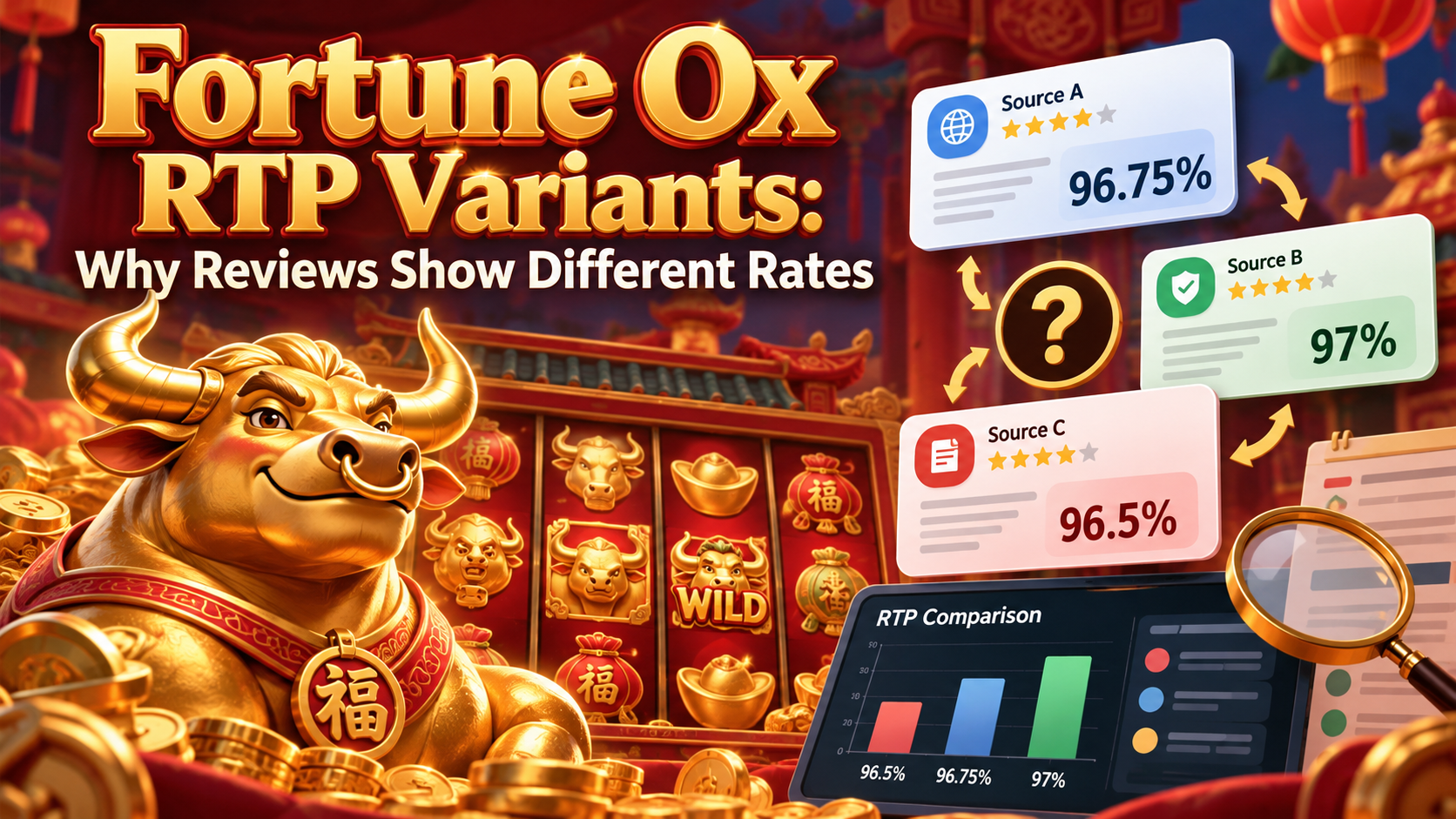
Search for the RTP of Fortune Ox and most current reviews will show 96.75%. Keep searching, however, and you may encounter pages that round the figure to 97%, display another percentage, or claim that different casino versions use different settings. For readers trying to compare slots accurately, these conflicting numbers can make a simple specification surprisingly confusing.
A listing such as betfm can be used as one reference point, but an RTP figure should always be checked against provider information and the version of the game actually available to the player. Repeated numbers in search results are not automatically independent confirmation of the same fact.
For cannabis stores and dispensaries, the issue has a familiar parallel. POS platforms, inventory systems, loyalty tools, and reporting dashboards can display different versions of what appears to be the same KPI. Understanding why Fortune Ox reviews disagree offers a useful lesson in verifying any important business metric.
What Is the Official Fortune Ox RTP?
PG SOFT's current Fortune Ox game-information document lists the theoretical Return to Player at 96.75%.
The provider also breaks that figure into two components:
- 72.58% attributed to the main game;
- 24.17% attributed to the Fortune Ox Feature;
- 96.75% overall theoretical RTP.
The same documentation describes Fortune Ox as a medium-volatility game with an overall hit rate of 21.32%.
These figures give readers a useful baseline when reviewing third-party pages.
When a review disagrees with current first-party documentation, the provider's specification should normally be the starting point for further verification.
Why Some Reviews Show About 97%
The simplest explanation is rounding.
A theoretical RTP of 96.75% can easily become 96.8% or approximately 97% in less technical content.
Mathematically:
96.75% rounded to one decimal place = 96.8%
96.75% rounded to the nearest whole percentage = 97%
Neither rounded figure necessarily indicates a different mathematical model. The problem occurs when a rounded number is presented as an exact specification.
Precision Matters in Comparison Content
The difference between 96.75% and 97% is small, but comparison articles often rank games using differences measured in tenths or hundredths of a percentage point.
In that context, rounding too early can create misleading comparisons.
For example:
- Game A: 96.75%;
- Game B: 96.90%.
If both are displayed simply as 97%, an actual specification difference disappears.
Rounding is useful for explanation, but exact values are better for product comparison.
Some Reviews May Be Outdated or Simply Wrong
Online slot reviews are frequently copied, rewritten, syndicated, or updated without every technical specification being independently checked.
An incorrect RTP can therefore spread across several domains.
A page might contain inaccurate information because the writer:
- copied another review;
- confused Fortune Ox with another Fortune-series title;
- rounded a value without explaining it;
- relied on an older database;
- mixed theoretical and observed RTP;
- entered a figure manually and made an error.
This is why searching betfm.com or several other review sites can produce apparent consensus without proving where the original number came from.
A trustworthy review should make its source clear.
Theoretical RTP and Actual RTP Are Not the Same
Another source of confusion is the word “RTP” itself.
The UK Gambling Commission distinguishes theoretical RTP from actual RTP in its guidance on Return to Player performance.
Theoretical RTP is built into the game's mathematical design.
Actual RTP is calculated from real turnover and winnings over a selected period.
The formula is essentially:
actual RTP = total winnings ÷ total amount wagered
Suppose players collectively wager $100,000 on a game and receive $94,000 in prizes during the measured period.
The observed RTP would be:
$94,000 ÷ $100,000 = 94%
That does not automatically mean the theoretical RTP has changed from 96.75%.
Sample Size Changes the Picture
Actual results fluctuate.
With a relatively small number of spins, observed RTP can sit substantially above or below the mathematical target. As the amount of play increases, the expected range around theoretical RTP becomes narrower.
The UK Gambling Commission specifically notes that volatility must be considered when evaluating these deviations.
A short-term actual RTP figure describes what happened; theoretical RTP describes how the game is designed over a very large sample.
Confusing the two can create apparently contradictory reviews even when both percentages are calculated correctly.
Can Fortune Ox Have Different RTP Configurations?
Some slot databases and review sites report that lower-RTP Fortune Ox configurations may exist in the market. That possibility should be treated differently from PG SOFT's clearly documented 96.75% default specification.
The safest approach is not to assume that every casino necessarily serves an identical configuration—or that a third-party claim about alternative settings is automatically correct.
Instead, check:
- the game's own information or help screen;
- the provider documentation;
- the casino's displayed RTP;
- the exact game version, where visible.
The RTP shown by the playable game matters more than a percentage copied from a generic review.
That principle is especially important when comparing operators.
Why 72.58% Is Sometimes Misunderstood
PG SOFT's documentation contains another percentage that can create confusion: the main-game contribution of 72.58%.
This is not the overall Fortune Ox RTP.
The provider divides the total theoretical return into:
- 72.58% from the main game;
- 24.17% from the Fortune Ox Feature.
Together:
72.58% + 24.17% = 96.75%
A writer who sees the table without understanding its structure could incorrectly present one component as the game's full RTP.
This demonstrates an important SEO-content principle: technical numbers need labels and context, not just transcription.
RTP Does Not Predict Your Next Session
Even when 96.75% is the correct theoretical rate, it should not be interpreted as a promise that $100 in wagers will return $96.75 during one playing session.
RTP operates across a very large number of outcomes.
One short session might return:
- considerably less than the amount wagered;
- approximately the same amount;
- more than the starting amount;
- an unusually large win.
None of those outcomes independently confirms or disproves the theoretical rate.
The UK Gambling Commission explains that RTP is an average achieved across a significant volume of play rather than a guaranteed return on each session.
RTP is a long-term mathematical characteristic, not a personal cashback percentage.
RTP and Volatility Answer Different Questions
Fortune Ox is classified by PG SOFT as medium volatility.
That specification should not be confused with its 96.75% RTP.
RTP addresses long-term theoretical return.
Volatility addresses how unevenly that return may be distributed among outcomes.
Two slots can share the same RTP while producing very different playing experiences.
One may distribute more value through relatively common smaller wins, while another concentrates more value in less frequent larger outcomes.
A complete review should therefore discuss both metrics rather than treating RTP as a universal measure of game quality.
How to Check an RTP Claim Properly
Readers comparing Fortune Ox reviews can use a simple verification process.
Step 1: Find the Provider Figure
Start with current PG SOFT documentation.
For Fortune Ox, the current published theoretical overall RTP is 96.75%.
Step 2: Check the Game Information Screen
If playing through an operator, inspect the rules or information section of the actual game.
This helps determine whether the configuration being offered matches the figure in a review.
Step 3: Check the Publication Date
An old review may contain specifications that have not been verified recently.
Newer does not automatically mean more accurate, but an update date provides useful context.
Step 4: Look for a Source
A strong article should tell readers where an important numerical claim comes from.
If a page gives a precise RTP without citing provider information, treat it as a secondary source rather than definitive evidence.
What Cannabis Stores and Dispensaries Can Learn From RTP Disputes
Conflicting metrics are not unique to gambling.
A dispensary may discover that its POS dashboard reports one sales number while accounting software or an analytics platform reports another.
The immediate assumption is often that one system is broken.
Frequently, however, the systems are measuring different things.
One report may use:
- gross sales;
- net sales;
- sales after discounts;
- sales excluding refunds;
- completed transactions only;
- a different reporting timezone.
Inventory numbers can differ for similar reasons, including synchronization delays, transfer status, adjustments, or different definitions of available inventory.
Before deciding which number is correct, determine whether the systems are actually calculating the same metric.
Build a Source-of-Truth Hierarchy
Cannabis retailers can use the same verification logic applied to Fortune Ox RTP.
For every important KPI, document:
- the metric definition;
- the authoritative data source;
- the calculation method;
- the reporting period;
- the refresh frequency;
- any exclusions or adjustments.
For example, “net sales” should have one agreed definition across headquarters, store managers, finance teams, and marketing.
Without that agreement, two dashboards can both calculate their numbers correctly while still disagreeing.
Avoid Spreadsheet Consensus
Another useful lesson is that repetition does not establish accuracy.
If five manually maintained spreadsheets all copy data from the same incorrect source, having five matching numbers does not make the number more reliable.
The same problem occurs when gambling reviews copy one another.
Independent verification is more valuable than repeated secondary information.
How SEO Reviews Should Handle Different RTP Figures
A useful review should not hide discrepancies.
If sources disagree, the article should explain:
- what the current provider documentation says;
- which alternative figures appear elsewhere;
- whether differences may result from rounding;
- whether actual and theoretical RTP are being confused;
- whether alternate configurations are documented;
- what readers should check in the playable game.
This is more useful than simply choosing the highest or most common percentage.
It also builds stronger informational content because it answers the question behind the search: why do the numbers differ?
Final Takeaway
The strongest current first-party reference for Fortune Ox lists a theoretical RTP of 96.75%. Reviews may display different rates because of rounding, outdated information, transcription errors, confusion between game components, differences between theoretical and actual RTP, or reports of operator-specific configurations.
The practical solution is straightforward: verify the provider documentation and then check the information displayed in the exact game version being offered.
For dispensaries, the broader lesson is equally useful. Different dashboards do not necessarily mean different realities. They may reflect different definitions, sources, calculation rules, or reporting windows.
Reliable decisions begin by understanding how a number was produced—not by choosing the number that appears most often.



Top comments (0)