
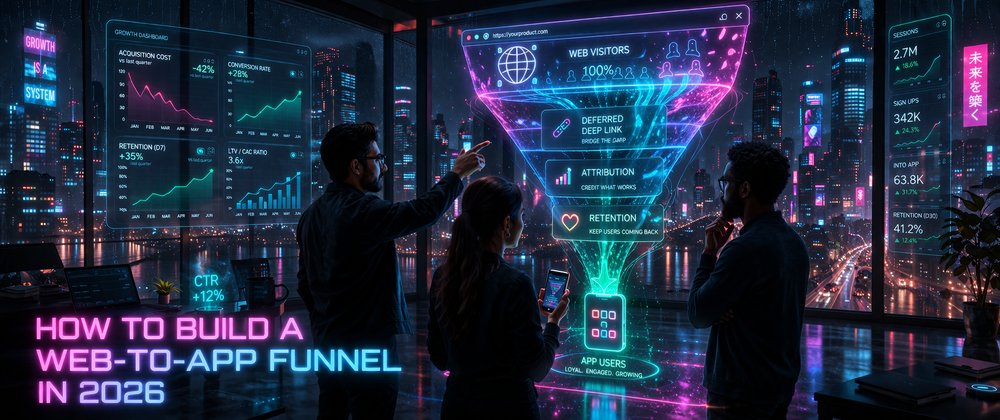

The digital landscape in 2026 has fundamentally shifted toward "app-first" retention, yet the "web-first" discovery model remains the most cost-effective way to acquire new users. As mobile ad costs on major networks continue to climb, businesses are increasingly bypassing direct app-store ads in favor of a more sophisticated bridge.
A web-to-app funnel is a strategic pathway that captures users on a mobile website and systematically transitions them into a native mobile application. In 2026, this is no longer just about a "Download our App" banner; it is a data-driven sequence that preserves user context, ensures frictionless onboarding, and significantly lowers Customer Acquisition Cost (CAC).
The 2026 Context: Why Web-to-App is Mandatory
In the current market, the "Web-to-App" strategy has moved from a growth hack to a foundational requirement. Apple’s ongoing refinements to App Tracking Transparency (ATT) and Google’s Privacy Sandbox have made direct-to-app attribution more complex and expensive. By starting the funnel on the web, brands can utilize first-party data (cookies and local storage) to build a profile before the user ever hits the App Store.
According to 2025 industry benchmarks, brands utilizing a dedicated web-to-app bridge see a 25–30% increase in Long-Term Value (LTV) compared to users who only interact with the web version. The native app environment offers 2026-standard features like advanced push notifications, biometric security, and offline functionality that the mobile web simply cannot replicate with the same level of performance.
Core Framework: The Three-Stage Transition
1. The Contextual Hook (Web Layer)
The funnel begins by solving a specific problem on the mobile web. In 2026, users are resistant to "forced" app downloads. The most successful funnels use "Feature Gating" or "Value-Add" hooks. For instance, a user might browse a travel site, but the "Real-Time Flight Tracking" or "AR Room Preview" is labeled as an app-only feature.
2. The Persistent Bridge (Deep Linking)
The bridge is the technical infrastructure connecting the web click to the app install. This requires Deferred Deep Linking. Unlike standard deep links, deferred deep links remember where the user was on the website even after they visit the App Store and install the app. When the app opens for the first time, the user is greeted with the exact product or page they were looking at on the web, rather than a generic home screen.
3. The Onboarding Handshake
This is where the transition is finalized. The app must recognize the "Web-to-App" intent. If a user was mid-checkout on the web, the app should instantly populate that cart. This continuity is what separates high-performing funnels from those that lose users at the install gate.
Real-World Implementation and Geographic Nuance
Implementation details often vary based on your technical headquarters and target market. For companies seeking localized expertise, collaborating with a partner specializing in Mobile App Development in Maryland can ensure that the funnel architecture complies with regional data privacy expectations while maintaining high-speed performance for North American users.
In practice, a fintech startup in 2025 implemented a "Snapshot" web tool that allowed users to scan a credit card offer. To see their actual approval odds, the user was directed to the app via a deferred deep link. By capturing the email on the web first, the company saw a 40% reduction in "abandoned installs" because they could follow up via email if the App Store journey was interrupted.
Step-by-Step Technical Execution
- Map the High-Value Entry Points: Identify the web pages with the highest mobile traffic but lowest conversion. These are your prime candidates for the app bridge.
- Configure Universal Links (iOS) and App Links (Android): Ensure your digital asset links are properly hosted on your domain to allow seamless redirection.
- Deploy a Smart Banner System: Move away from static banners. Use dynamic banners that change based on user behavior (e.g., showing the banner only after the user has spent 30 seconds on a page).
- Implement Attribution Logic: Use a 2026-compliant attribution provider to track which web campaigns are driving the most high-value app users.
- Test the "First Open" Experience: Use a clean device to ensure that the deferred deep link places the user exactly where they expect to be after the download.
For those focusing on the technical nuances of these platforms, referencing a mobile app development complete founder guide can provide additional clarity on the underlying architecture required for cross-platform stability.
AI Tools and Resources
Branch.io — The industry standard for deep linking and attribution
- Best for: Managing deferred deep links across various social and search channels.
- Why it matters: It handles the complex "edge cases" of link redirection that often break the user experience.
- Who should skip it: Small teams with a single-platform app and very low traffic.
- 2026 status: Active; recently updated with enhanced privacy-first attribution models.
AppsFlyer Smart Banners — Dynamic web-to-app banner creation
- Best for: Non-technical marketing teams who need to deploy and A/B test web banners.
- Why it matters: Allows for "creative-level" attribution to see which banner designs convert best.
- Who should skip it: Developers who prefer building custom, light-weight native banners.
- 2026 status: Active; features new predictive modeling for 2026 user behavior patterns.
Posthog — Open-source product analytics with session recording
- Best for: Understanding exactly where users drop off in the web-to-app transition.
- Why it matters: Session replays show if a banner is blocking critical web content or if the redirect is confusing.
- Who should skip it: Organizations with strictly regulated data residency requirements that cannot use cloud-based analytics.
- 2026 status: Active; widely used for its robust "feature flag" capabilities.
Risks, Trade-offs, and Limitations
Building a web-to-app funnel involves navigating significant friction points that can lead to total execution failure if ignored.
When Web-to-App Fails: The "Blind Entry" Scenario
If the deferred deep linking logic is not perfectly synchronized with the app’s routing system, the user is dropped onto a generic login screen after installation.
- Warning signs: High install rates coupled with a 90% "First-Minute" churn rate.
- Why it happens: The app’s router is initialized before the attribution SDK can pass the deferred URL parameters.
- Alternative approach: Implement a "Loading/Syncing" state upon the first app launch to ensure the deep link data is retrieved before the UI is rendered.
Cost Failure: The Attribution Double-Dip
Businesses often find themselves paying for the same user twice—once for the web click and again if they run retargeting ads to "remind" the user to open the app.
- Warning signs: Marketing spend increasing while "Blended CAC" remains stagnant.
- Alternative approach: Use first-party cookies to exclude current web visitors from app-install retargeting campaigns for 48 hours.
Key Takeaways
- Prioritize Context Over Volume: A user who enters the app with their web-browsing context intact is 3x more likely to convert than one who starts from the home screen.
- Invest in Deferred Deep Linking: This is the non-negotiable technical bridge for any funnel built in 2026.
- Use Web for Discovery, App for Retention: Stop trying to force high-level discovery in the App Store; use the web’s SEO and social reach to feed the funnel.
- Monitor the Handshake: The transition between the "Install" button and the "App Open" is the most fragile part of the journey; audit it weekly.
By treating the web and the app as a singular, fluid ecosystem rather than two competing platforms, brands can build a sustainable growth engine that thrives despite the rising costs of the modern mobile market.



Top comments (1)
This app tutorial was one of the best resources I found online. The information was well structured and easy to understand. After reading the guide, I visited xupertvpc.com and used the Link Aquí to Descargar the application. My experience with Xuper TV App has been very positive because the platform is responsive and simple to navigate. Finding movies, live channels, and other content takes only a few moments. The article itself was written in a way that feels natural and user focused. I would definitely recommend it to anyone looking for reliable guidance.