
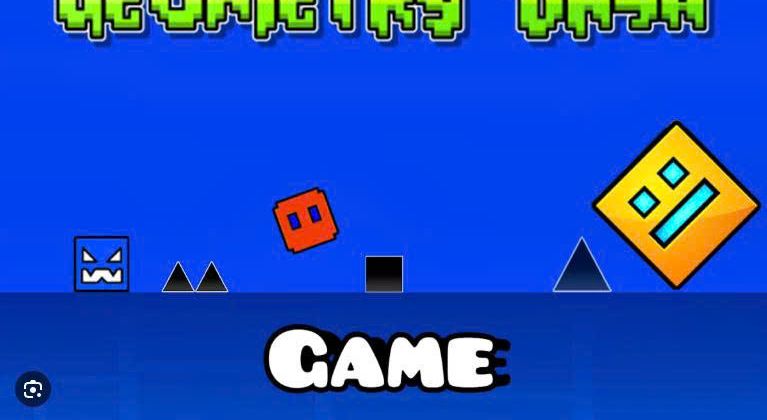

Ever found yourself tapping your foot to a beat while simultaneously wanting to tear your hair out in frustration? Welcome to the wonderfully maddening world of rhythm-based platformers, where split-second timing meets geometric obstacles in a dance of digital destruction. Today, we're diving deep into Geometry Dash, the game that has turned countless players into both musical virtuosos and keyboard-smashing maniacs.
What Makes This Geometric Journey So Captivating?
At its core, this isn't just another platformer – it's a symphony of sight and sound where every jump, dodge, and flip must align perfectly with the underlying soundtrack. Picture this: you're controlling a small geometric shape (usually starting as a simple cube) that automatically moves forward through increasingly complex obstacle courses. Your only job? Don't crash into anything. Sounds simple, right? Think again.
The magic lies in how the game synchronizes visual elements with audio cues. Every spike, platform, and obstacle placement corresponds to beats, rhythms, and musical phrases. This creates an almost hypnotic experience where successful navigation feels like conducting an orchestra with your fingertips. The geometric aesthetic isn't just for show – those clean lines and bright colors help players quickly identify threats and safe spaces during high-speed sequences.
Breaking Down the Core Gameplay Elements
The fundamental mechanic revolves around a single input: the jump. Tap, click, or press space to make your character leap over gaps and spikes. However, this simplicity becomes beautifully complex as you encounter different vehicle modes throughout each level.
Cube Mode forms the foundation – basic jumping with gravity doing the rest. Ship Mode gives you complete flight control, requiring you to navigate through tight corridors by holding and releasing your input. Ball Mode flips everything upside down (literally), inverting your gravity with each tap. UFO Mode provides shorter, more controlled bursts of flight, while Wave Mode offers continuous diagonal movement that demands precise timing.
Each mode requires a different mental approach. Ship sections often flow like breathing exercises – smooth, controlled movements that follow the music's rhythm. Ball segments feel more like puzzle-solving, where you're constantly calculating trajectory changes. Wave mode? That's pure muscle memory and reaction time.
The visual design supports gameplay brilliantly. Bright, contrasting colors make hazards immediately recognizable, while the geometric shapes create clear boundaries. Portal transitions between modes are telegraphed well in advance, giving players time to mentally shift gears.
Essential Strategies for Geometric Success
Start with the rhythm, not the visuals. Many newcomers focus intensely on watching for obstacles, but the audio cues often provide better timing guidance. Play levels multiple times just listening to the music, noting where major beats align with jumping requirements. Your ears will often react faster than your eyes during complex sequences.
Practice patience with progression. Unlike traditional games where you might lose some progress, here you restart completely after each collision. This isn't punishment – it's the design working as intended. Each restart gives you another opportunity to internalize the rhythm and movement patterns. Celebrate small victories: making it 10% further than your previous attempt represents real improvement.
Develop mode-specific muscle memory. Spend time in practice mode (when available) focusing on each vehicle type separately. Ship control requires smooth, flowing movements – imagine drawing gentle waves with your input timing. Ball mode needs precise, deliberate inputs – think staccato musical notes. Wave mode demands constant micro-adjustments – like fine-tuning a radio frequency.
Use visual anchors strategically. While rhythm provides primary timing, certain visual elements serve as excellent reference points. Look for color changes, background elements, or specific obstacle arrangements that consistently precede difficult sections. These become your "get ready" signals.
Manage frustration constructively. When you hit that inevitable wall (sometimes literally), step away briefly. Your brain continues processing movement patterns subconsciously. Returning after a short break often results in surprising improvement. Keep hydrated, take breaks, and remember that mastery requires time.
Customize your experience. Adjust visual settings to reduce distractions if needed. Some players prefer lower brightness levels to focus on essential elements, while others benefit from higher contrast settings. Find what works for your visual processing style.
The Rhythmic Road Ahead
Mastering Geometry Dash platformers represents a unique achievement in gaming. Unlike shooters or strategy games that rely primarily on knowledge or reaction speed, these experiences demand a harmony between auditory processing, muscle memory, and spatial reasoning. Success feels earned in a way that few other genres can match.
The beauty of this particular geometric adventure lies in its democratic difficulty curve. Everyone starts with the same simple levels, building fundamental skills before tackling community-created monsters that would make seasoned gamers weep. Yet even after hundreds of hours, you'll discover new techniques, shortcuts, or rhythm patterns that make familiar levels feel fresh.
Whether you're seeking a quick reflexes challenge, musical gaming experience, or just want to understand what all the geometric fuss is about, diving into this rhythmic world offers rewards far beyond simple completion. It's meditation through controlled chaos, creativity through constraint, and ultimately, a uniquely satisfying way to merge your musical and gaming instincts into something beautifully geometric.
Ready to jump in? Your geometric journey awaits.



Top comments (0)