
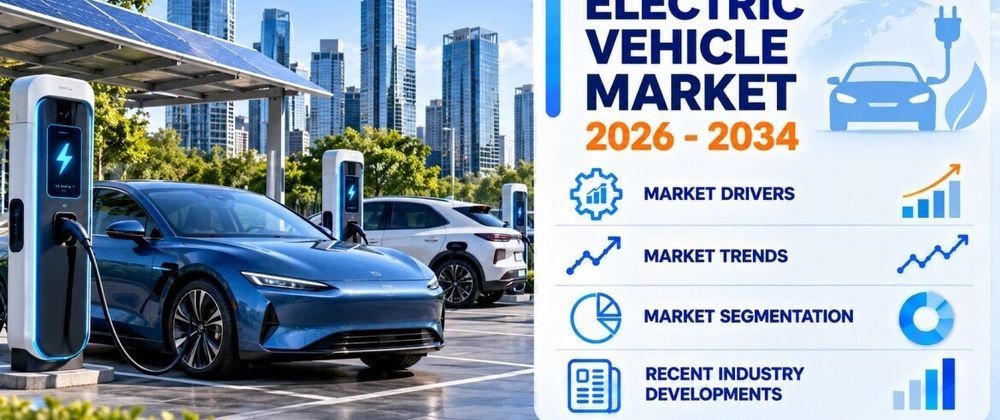

IMARC Group, a leading global market research and management consulting firm, has published its latest market intelligence report on the electric vehicle market. The global electric vehicle market grew from USD 917.3 Billion in 2025 to USD 1,104.3 Billion in 2026. Looking forward, IMARC Group estimates the market to reach USD 4,886.2 Billion by 2034, exhibiting a CAGR of 20.43% from 2026-2034. Growth is driven by the rapid expansion of public and private charging infrastructure, rising environmental sustainability concerns and the need to cut transport emissions, continuous advances in battery technology and range, and supportive government policies and incentives across major automotive economies.
The market is gaining strong momentum as electric mobility moves from early adoption to mainstream purchase. About one in four new cars sold worldwide is now electric, and the International Energy Agency (IEA) expects annual global electric car sales to approach 23 million units, close to 30% of all new cars sold. Automakers are broadening their portfolios across hybrids, plug-in hybrids, battery electric cars, trucks, and fuel cell models, while falling battery costs and new platform architectures are pushing entry prices toward those of conventional vehicles. Charging networks are scaling in parallel, supported by ultra-fast charging technology and integration with renewable energy sources. Trade, localization, and industrial policy are also reshaping where electric vehicles are built and sold. Together, these forces are turning electrification into a core strategic priority for automakers, battery makers, utilities, and governments worldwide.
Electric Vehicle Market at a Glance:
- Market Size 2025: USD 917.3 Billion
- Market Size: 2034: USD 1,104.3 Billion
- Forecast Market Size: USD 4,886.2 Billion
- Growth Rate 2026-2034: CAGR of 20.43%
- Leading Charging Type: Slow charging, with around 71.2% of the market share
- Leading Propulsion Type: Hybrid electric vehicle (HEV), with around 61.3% of the market share
- Leading Vehicle Type: Passenger vehicles, with around 73.5% of the market share
- Dominant Region: Asia Pacific, holding a market share of over 46.5%
How AI is Reshaping the Future of the Electric Vehicle Market
- AI-Driven Battery Health Intelligence and Predictive Maintenance: Battery condition is the single biggest driver of an electric vehicle’s uptime and resale value, and AI is making it measurable. Indian EV maker Omega Seiki Mobility has partnered with Electra AI to deploy real-time battery monitoring, predictive analytics, and state of health and remaining useful life estimates across its electric three-wheeler and commercial EV fleet. The aim is to reduce unplanned downtime, strengthen warranty management, and support a transparent used EV market.
- Advanced Driver Assistance and Autonomous Mobility at Scale: AI-based driver assistance is now a mass-market feature rather than a premium option. BYD reports more than 3.52 million vehicles on the road equipped with its God’s Eye driver-assistance systems. Hyundai is building IONIQ 5 based robotaxis at its Georgia Metaplant for autonomous ride-hailing operators including Waymo, showing how electric platforms are becoming the default foundation for self-driving fleets.
- Software-Defined Vehicles and In-Car AI Assistants: The IEA’s latest Global EV Outlook added a dedicated section on automotive software and AI, reflecting how central intelligence has become to vehicle value. Hyundai’s IONIQ 3, with a range of up to 497 km, is the first Hyundai in Europe to feature the Pleos Connect infotainment platform, built on Android Automotive OS with the Gleo AI in-car companion.
Grab a sample PDF of this report: https://www.imarcgroup.com/electric-vehicles-market/requestsample
Electric Vehicle Market Trends and Drivers:
The global electric vehicle market is expanding on the back of a powerful combination of energy security concerns, tightening emission goals, and visibly better products. According to the IEA, nearly 90 countries recorded year-on-year growth in electric vehicle sales in March alone, with about 30 posting record monthly sales as elevated fuel prices pushed buyers toward electric options. Charging availability is a foundational enabler of this shift. The United States now has more than 77,000 publicly accessible charging stations hosting over 236,000 public ports, and private capital added roughly 18,000 fast-charging ports in a single year, showing that infrastructure investment is increasingly commercially led rather than dependent on public funding alone.
Electrification also carries a clear structural and sustainability logic. Per the IEA, about 5% of the global car stock is now electrified, and that fleet is already displacing around 1.2 million barrels of oil per day. Trade has become a defining feature of the market: roughly one quarter of electric cars produced are sold across borders, and in markets outside China, Europe, and the United States, around 55% of electric cars sold are imported from China, compared with less than 5% five years earlier. Chinese automakers account for about 60% of global electric car sales, which is reshaping competitive dynamics, pricing, and localization strategies for every other player.
Advances in battery chemistry and ultra-fast charging are removing the practical barriers of range and charging time. BYD’s flash charging system uses a 1,500 kW architecture that can take a battery from 10% to 70% in about five minutes, and the company has built 10,000 flash-charging stations across 332 Chinese cities with thousands more planned overseas. Volkswagen is expanding unified-cell gigafactories with a combined volume of up to 200 GWh, while Toyota’s new North Carolina battery plant is designed for up to 30 GWh annually. As performance improves and costs fall, regulators are responding with battery durability rules, charging corridor mandates, and trade defence measures, which sets the stage for the policy landscape that increasingly shapes demand.
Global Regulatory, Trade, and Sustainability Landscape Shaping Demand:
- United Nations Economic Commission for Europe, UN GTR No. 22: This global technical regulation sets minimum in-vehicle battery durability for light-duty battery electric and plug-in hybrid vehicles, requiring at least 80% energy retention for 5 years or 100,000 km and 70% for 8 years or 160,000 km. It is being progressively integrated into regional rules across Europe, North America, and Japan, giving buyers and used EV markets greater confidence in battery life.
- International Energy Agency, Global EV Outlook: Around 40 countries now record electric vehicles at 10% or more of new car sales, with Norway leading at about 97%. The IEA also highlights that roughly one quarter of electric cars produced are traded internationally, making cross-border trade policy a central demand variable.
- European Union, Trade Defence Measures and WTO Dispute: Countervailing duties of 7.8% to 35.3% apply to China-made battery electric vehicles on top of the standard 10% import duty on cars. In January, the Commission issued guidance allowing Chinese exporters to offer minimum-price undertakings as an alternative to duties, and the first undertaking has since been accepted. China has also initiated a WTO dispute against the duties.
- European Union, Alternative Fuels Infrastructure Regulation: The regulation requires charging pools of at least 400 kW, including at least one 150 kW point, every 60 km along the core trans-European transport network for cars and vans. It also mandates 350 kW points for heavy-duty vehicles, with full network coverage targeted over time.
- World Meteorological Organization, Climate Context: The WMO reports that atmospheric carbon dioxide concentration has risen by 11.4% over the past 20 years. Electric vehicles produce zero tailpipe emissions, which keeps transport electrification central to national climate and air quality strategies.
Key Government Schemes and Policy Programs Supporting the Industry:
- India, PM E-DRIVE Scheme: The scheme has an outlay of INR 11,900 crore and supports incentives for approximately 28.30 lakh electric vehicles, with 26.59 lakh sales enabled so far. It allocates INR 4,391 crore for 14,028 electric buses, INR 2,000 crore for public charging stations, and INR 780 crore for testing agency upgrades, with an electric two-wheeler incentive of INR 2,500 per kWh capped at INR 5,000 per vehicle.
- United States, NEVI and CFI Programs: The National Electric Vehicle Infrastructure program provides USD 5 billion to states for highway fast charging, complemented by USD 2.5 billion in competitive Charging and Fueling Infrastructure grants. Congress rescinded just over USD 500 million in NEVI funding in January, and the federal consumer tax credit of up to USD 7,500 has ended, shifting momentum toward private charging investment and state programs.
- European Union, Automotive Package and Battery Support: The Commission’s automotive package proposed easing the fleet CO2 reduction target for new cars from 100% to 90%, alongside a EUR 1.8 billion package to build an EU-made battery value chain. In November, the Parliament’s Environment Committee voted 48 to 30 to adopt a position easing the rules further, with a full Parliament vote and negotiations with member states still to come.
- China, New Energy Vehicle Tax Policy: The purchase tax exemption has been replaced by a 50% reduction, an effective rate of 5%, with relief capped at CNY 15,000 per vehicle. Trade-in grants of up to CNY 20,000 remain available, and new energy vehicles already exceed 50% of new passenger vehicle sales.
- United Arab Emirates, National Electric Vehicle Strategy: The strategy aims for electric vehicles to make up 50% of all vehicles on the road, supported by incentives, tax exemptions, reduced registration fees, and charging network expansion across the Middle East and Africa region.
Electric Vehicle Industry Segmentation:
The report has segmented the market into the following categories:
Breakup By Component:
- Battery Cells and Packs
- On-Board Charger
- Fuel Stack
Battery cells and packs are central to the market, driven by gains in energy density and range and by rising research and development investment in battery technology. The on-board charger segment benefits from expanding charging networks and faster charging technologies, while the fuel stack segment is supported by government-backed research into hydrogen fuel cell technology as a clean energy source for future electric vehicles.
Breakup By Charging Type:
- Slow Charging
- Fast Charging
Slow charging leads the market with around 71.2% of the market share, driven by its lower cost, easier installation, and suitability for home users and small-scale charging sites. It places lower power demand on the grid, supports battery lifespan, and fits overnight and workplace parking use, which keeps it the preferred option for most owners.
Breakup By Propulsion Type:
- Battery Electric Vehicle (BEV)
- Fuel Cell Electric Vehicle (FCEV)
- Plug-In Hybrid Electric Vehicle (PHEV)
- Hybrid Electric Vehicle (HEV)
Hybrid electric vehicles lead the market with around 61.3% of the market share, supported by strict emission regulations, higher fuel efficiency, and their role as a bridge between conventional engines and fully electric driving. Continuous improvements in hybrid powertrains, rising fuel prices, and government incentives continue to attract environmentally conscious buyers.
Breakup By Vehicle Type:
- Passenger Vehicles
- Commercial Vehicles
- Others
Passenger vehicles lead the market with around 73.5% of the market share, driven by changing consumer preferences, rapid urbanization, and rising disposable incomes in emerging economies. Connected car features, stricter emission norms, favorable financing options, and the growth of ride-sharing and car-sharing services are encouraging automakers to invest heavily in electric and hybrid passenger cars.
Breakup By Region:
- Asia Pacific (China, Japan, India, South Korea, Australia, Indonesia, Others)
- Europe (Norway, Netherlands, Sweden, United Kingdom, France, Germany, Others)
- North America (United States, Canada)
- Middle East and Africa (Turkey, Saudi Arabia, Iran, United Arab Emirates, Others)
- Latin America (Brazil, Mexico, Argentina, Colombia, Others)
Asia Pacific dominates the global electric vehicle market with the largest regional share of over 46.5%, driven by strict emission regulations, ambitious electrification targets, rapid urbanization, and growing concern over congestion and air quality. Advances in battery technology, supportive tax incentives and subsidies, expanding charging infrastructure, and a growing middle class with rising disposable income are further accelerating adoption across China, Japan, India, and South Korea.
Competitive Landscape:
The report provides a comprehensive analysis of the competitive landscape in the electric vehicle market with detailed profiles of all major companies, including:
- BYD Company Limited
- BMW Group
- Chevrolet (General Motor Company)
- Ford Motor Company
- Hyundai Motor Group
- Mercedes-Benz Group AG
- Mitsubishi Motors Corporation
- Nissan Motor Corporation
- Tesla, Inc.
- Toyota Motor Corporation
- Volkswagen Group
Leading players are accelerating advances across manufacturing, charging, and battery innovation. BYD says its new energy vehicle business spans more than 120 countries and regions, with cumulative global sales surpassing 18.2 million units. Tesla delivered 486,532 vehicles in a single quarter while deploying 13.7 GWh of energy storage, and Toyota has launched a USD 13.9 billion battery plant with up to 30 GWh of annual capacity. Ford has priced its new Universal EV Platform pickup, the Fathom, at USD 28,350, signalling a broader industry push toward affordable electric models.
Market Concentration Analysis:
- A Two-Way Race at the Top of Battery Electric Sales: BYD delivered 557,090 battery electric vehicles in the second quarter against 480,126 for Tesla, according to market tracking data. Counterpoint Research puts Tesla at nearly 12% of global battery electric sales in that quarter, so leadership is concentrated at the top but remains closely contested.
- Chinese Manufacturers Driving Scale and Overseas Expansion: Chinese automakers account for about 60% of global electric car sales, according to the IEA. BYD sold about 497,000 new energy vehicles outside China in the first half, up 81.4%, which lifted it to third place among global sellers excluding China, ahead of Hyundai Motor Group.
- Established Groups Defending Regional Strongholds: Volkswagen Group led all automakers outside China with 635,000 electric vehicle deliveries in the first half, up 7.6%. Hyundai reported record first-half sales of 595,457 units in North America, showing that incumbents retain strong regional positions even as Geely, Chery, and other challengers gain share.
What Does The Full Report Cover?
If you are tracking the electric vehicle market for investment decisions, market entry planning, competitive benchmarking, or strategic advisory, IMARC Group’s report gives you everything in one place:
- Complete market sizing with revenue forecasts in USD Billion and unit volumes in Million Units covering the full projection period
- Quantified growth driver, restraint, opportunity, and challenge analysis across component, charging type, propulsion type, vehicle type, and regional markets
- Sub-segment breakdowns for battery cells and packs, on-board chargers, fuel stacks, slow and fast charging, BEV, FCEV, PHEV, HEV, passenger vehicles, and commercial vehicles with individual share data
- Country-level data for China, Japan, India, South Korea, Australia, Indonesia, Norway, the Netherlands, Sweden, the United Kingdom, France, Germany, the United States, Canada, Turkey, Saudi Arabia, Iran, the United Arab Emirates, Brazil, Mexico, Argentina, and Colombia
- Competitive profiles of 11 leading companies with strategic landscape assessment
- Porter’s Five Forces analysis to assess new entrants, competitive rivalry, supplier power, buyer power, and the threat of substitution
- Latest innovation trends covering solid-state and high-energy-density batteries, ultra-fast charging, hydrogen fuel cells, and charging networks integrated with renewable energy, along with 10% free customization and 10 to 12 weeks of post-sale analyst support
Recent News and Developments in Electric Vehicle Market
- October 2026: BYD recorded its strongest monthly sales performance of the year, with battery electric vehicle deliveries topping 300,000 units for the first time at 305,743 units, up 37% year over year. Total passenger new energy vehicle deliveries reached 483,125 units, while overseas passenger vehicle and pickup sales exceeded 1.34 million units across the first nine months, up 92%.
- October 2026: Tesla reported delivering 486,532 vehicles in the third quarter, beating the analyst consensus of 461,974 by more than 24,000 units. The company also deployed 13.7 GWh of energy storage products, up 9.6% from a year earlier, with Model 3 and Model Y accounting for 478,237 of total deliveries.
- August 2026: Ford unveiled the Fathom, a midsize electric pickup starting at USD 28,350, or USD 29,945 including destination, and the first vehicle built on its new Universal EV Platform. The truck will be built at the Louisville Assembly Plant in Kentucky and targets fleet and mainstream buyers with a sub-USD 30,000 entry price.
- August 2026: Hyundai Motor outlined plans to launch or refresh more than 100 models, including its first extended-range electric vehicle and the Europe-focused IONIQ 3 with up to 497 km of range. The company also reported record first-half North America sales of 595,457 units, supported by hybrid demand and electrified lineup growth.
- June 2026: Volkswagen began production of the ID. Polo and the Cupra Raval at its Martorell plant in Spain, a site that received around EUR 3 billion in investment and can build up to 300,000 electric cars annually. The ID. Polo starts from EUR 24,995 in Germany, bringing electric driving to a mass-market price point.
- November 2025: Toyota started production at its USD 13.9 billion battery manufacturing facility in North Carolina, its first battery plant outside Japan. The site will produce up to 30 GWh annually across 14 production lines, create about 5,000 jobs, and was accompanied by a further USD 10 billion pledge for U.S. investment over the next five years.
Note: If you require specific details, data, or insights that are not currently included in the scope of this report, we are happy to accommodate your request. As part of our customization service, we will gather and provide the additional information you need, tailored to your specific requirements. Please let us know your exact needs, and we will ensure the report is updated accordingly to meet your expectations.
Key Questions This Report Answers
- What is the current global electric vehicle market size and what is its projected value?
- Which charging type segment holds the largest share in the global electric vehicle market?
- Which propulsion type and vehicle type lead the global electric vehicle market?
- Which region dominates the global electric vehicle market and why?
- What are the key drivers of global electric vehicle market growth?
- How are battery technology, ultra-fast charging, AI, and government policies reshaping product development and competitive strategies in the electric vehicle industry?
- Who are the top companies in the global electric vehicle market and what are their competitive strategies?
- What are the investment and market entry opportunities across battery, charging, hybrid, and commercial electric vehicle segments?
About Us:
IMARC Group is a global management consulting firm that helps the world’s most ambitious changemakers to create a lasting impact. The company provides a comprehensive suite of market entry and expansion services. IMARC offerings include thorough market assessment, feasibility studies, company incorporation assistance, factory setup support, regulatory approvals and licensing navigation, branding, marketing and sales strategies, competitive landscape and benchmarking analyses, pricing and cost research, and procurement research.
Media and Sales Contact
IMARC Group
Email: sales@imarcgroup.com
United States: +1-201-971-6302
India: +91-120-433-0800
United Kingdom: +44-753-714-6104



Top comments (0)