

Law firms have a legitimate timekeeping problem. Lawyers move rapidly between email, calls, documents, meetings, research, messaging, and matter systems. Work gets fragmented, timers are forgotten, and reconstructing a day at 8 p.m. is unreliable.
Passive capture promises a better approach: use activity from approved business systems to help lawyers remember work and prepare time entries for review.
But there is a nearby technology category that looks much less benign: employee surveillance.
The distinction matters because workplace monitoring is expanding. An August 2026 Associated Press report described employers using digital and AI-driven systems to track communications, activity, productivity, and behavior, sometimes with limited transparency. The AP report illustrates why employees increasingly treat monitoring technology as a trust issue.
Legal timekeeping software should not assume it is exempt from that concern simply because its stated purpose is billing.
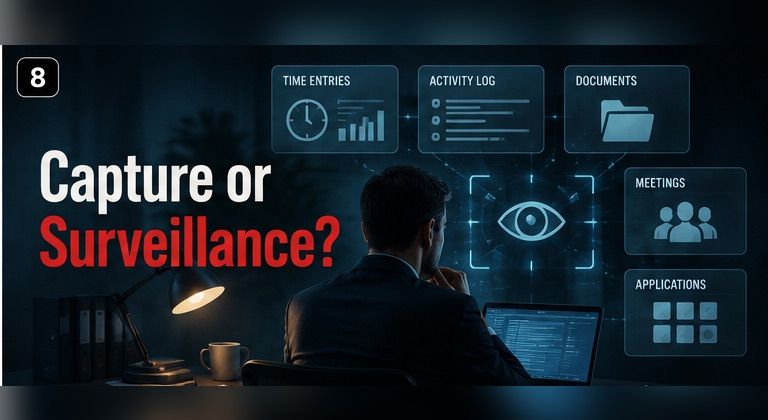
Capture and surveillance answer different questions
A useful passive time system asks, “What client work might this lawyer have forgotten to record?”
A surveillance system asks, “What was this employee doing, and were they productive enough?”
Those questions may use some of the same raw signals, but they create very different products.
A privacy-conscious passive time capture workflow should identify matter-related activity, organize it into useful suggestions, and place the lawyer in control of review. It does not need to score keystrokes, judge idle time, record screens continuously, or turn every digital trace into a management metric.
The closer a system moves toward behavioral scoring, the harder it becomes to describe it as merely a better timekeeping tool.
Law firms have additional reasons to be cautious
Ordinary workplace monitoring already raises privacy and trust concerns. Law firms also handle client confidential information.
A system that observes documents, emails, calendar events, calls, or browser activity may encounter sensitive matter details. That means architecture, retention, access controls, data minimization, and vendor practices become professional-risk questions, not just IT preferences.
The firm should know what data is captured, where it is processed, how long it is kept, who can see it, whether it is used to train models, and what happens to excluded or personal activity.
Lawyers should understand those boundaries too.
Invisible monitoring is a poor foundation for technology that depends on adoption.
Review control is the critical boundary
Passive capture works best when it behaves like memory assistance.
The software can suggest that a lawyer spent time drafting a document, participating in a client call, or corresponding about a matter. The lawyer then decides whether the activity was billable, confirms the matter, edits the description, adjusts the duration if appropriate, and approves the entry.
That workflow is consistent with good legal timekeeping practices because technology helps collect activity without eliminating professional judgment.
Automatic billing is much riskier. Context matters. A calendar event does not prove the entire meeting was billable. An open document does not prove continuous work. An email thread may span several matters or include administrative activity.
Capture can be automated more safely than judgment.
Firms should create a surveillance boundary before deployment
A useful policy should state what the system is for and what it will not be used for.
For example, the firm may use passive activity to help create time-entry suggestions but prohibit employee productivity scoring based on mouse movement, keyboard activity, or time spent in applications. Access to underlying activity can be limited, and personal or excluded systems can remain outside capture.
The purpose limitation matters because tools tend to expand once data exists.
A system introduced to recover missed billable time can gradually become a performance dashboard if governance is weak.
Better timekeeping should reduce friction, not create fear
The strongest argument for passive capture is that lawyers should spend less cognitive energy remembering timers and reconstructing their day.
If implementation makes people feel watched continuously, the firm has solved one workflow problem by creating another cultural one.
AI timekeeping becomes surveillance when the technology stops helping professionals document work and starts evaluating people through behavioral traces they cannot meaningfully control.
That boundary should be designed before rollout, not debated after trust has already been lost.
Originally published on the MIRA blog.



Top comments (1)
The post raises valid concerns about how AI could blur the line between efficiency and intrusion in professional settings. For a California immigration lawyer, this becomes especially relevant when dealing with sensitive client data visit website —especially for registered and bonded consultants who handle delicate immigration cases. The fear isn’t just about time tracking; it’s about ensuring AI tools don’t inadvertently expose confidential information or compromise attorney-client privilege.