

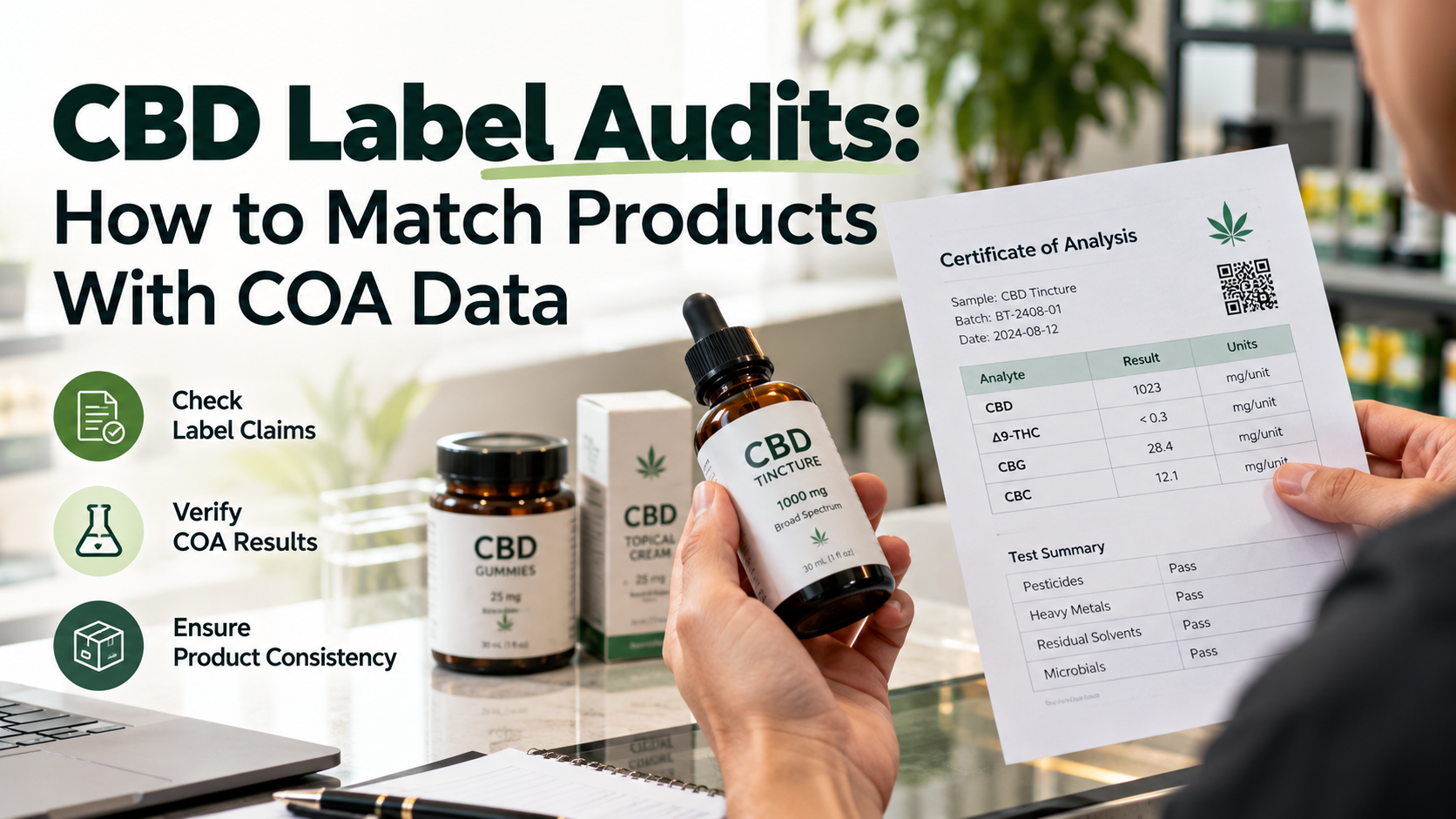
A CBD product label may look complete while still containing information that does not match the laboratory record behind the product. For retailers, that creates more than a merchandising problem. Incorrect cannabinoid values, lot numbers, serving information, or claims can create customer confusion and increase compliance risk.
Retail technology also connects product records with ecommerce, customer engagement, and tools such as CBD loyalty and rewards program software. If the original product data is inaccurate, the same mistake can spread across POS screens, online menus, receipts, promotions, and customer-facing product information.
A good CBD label audit verifies that the physical package, certificate of analysis, and digital product record describe the same product and the same production lot. The purpose is not simply to confirm that a COA exists, but to make sure it actually supports what is being sold.
What Is a CBD Label Audit?
A label audit is a structured comparison between a physical product and the records used to verify it. Depending on the product and jurisdiction, those records may include a COA, supplier documentation, batch information, and internal inventory data.
For a retailer, the audit should answer three basic questions:
- Is this the correct product?
- Does the COA belong to this batch or lot?
- Do important label claims match the supporting data?
A cbd store management software platform can help organize product information, but software cannot correct inaccurate supplier data unless somebody identifies the mismatch first.
Start With Product Identity
Before comparing cannabinoid numbers, confirm that the COA actually belongs to the item in your hand.
Match the Product and Lot
Look for identifiers that connect the label to the laboratory report, such as:
- product or SKU name;
- batch or lot number;
- manufacturer or brand;
- production date;
- test date;
- sample or report identifier.
The exact fields differ among laboratories and manufacturers. What matters is that staff can establish a clear connection between the sellable item and the laboratory result.
If a store receives several batches of the same CBD tincture, do not assume that one COA applies to all of them. Matching the product name alone is not enough when laboratory results are batch-specific.
Compare Cannabinoid Claims With COA Results
Once identity is confirmed, compare relevant cannabinoid information.
Depending on the product, the label may state total CBD, CBD per serving, THC content, or other cannabinoid values. The COA may report results using different units, so staff should understand whether they are comparing milligrams per unit, milligrams per gram, percentages, or another measurement.
Avoid Comparing Different Units Directly
A label may say “1,000 mg CBD” for an entire bottle while a laboratory report lists concentration per gram or milliliter. Those numbers cannot be compared without considering package size and measurement units.
During an audit, record:
- the value stated on the label;
- the value shown on the COA;
- the units used by each;
- package or serving size;
- any calculation needed to compare them.
A number that looks different is not automatically incorrect; first confirm that both records measure the same thing.
Review THC Information Carefully
THC content can be particularly important for hemp-derived products because legal definitions and retail requirements may depend on jurisdiction, product type, and testing methodology.
Do not rely on a front-label statement such as “THC free” without reviewing the supporting test result and the laboratory's reporting limits.
The FDA has historically tested marketed CBD products and published analytical results showing that label claims and measured cannabinoid content have not always aligned. Retailers can review FDA’s warning-letter and analytical-results resource for cannabis-derived products when developing supplier verification procedures.
Retailers should treat cannabinoid claims as data that needs supporting documentation, not simply marketing copy.
Check the COA Beyond CBD and THC
A useful COA may contain more than potency data. Depending on applicable requirements and the laboratory panel, it may include testing for contaminants such as pesticides, heavy metals, residual solvents, or microorganisms.
Retailers should define what documentation they expect from suppliers before inventory is accepted.
A receiving checklist may ask:
- Is the laboratory identified?
- Is the report associated with the correct batch?
- Is the test date reasonable for the product?
- Are expected testing panels present?
- Is the document complete and readable?
- Can staff retrieve it later?
Lab testing and COA management for CBD shops becomes more valuable when these checks are standardized instead of handled differently by each employee.
Audit Claims, Not Just Numbers
A technically accurate cannabinoid value does not automatically make the entire label appropriate.
Product labels and websites may contain statements about sleep, pain, anxiety, inflammation, or other health-related outcomes. In the United States, the regulatory treatment of claims depends on how a product is marketed and its product category.
FDA states that unapproved CBD products have not been evaluated to establish effectiveness for treating diseases and continues to warn about unproven therapeutic claims. It also states that, under current federal law, CBD cannot simply be marketed by adding it to conventional food or labeling it as a dietary supplement.
A COA can support analytical facts about a sample, but it does not validate medical or therapeutic marketing claims.
Retailers should involve qualified legal or compliance professionals when product classification or labeling requirements are unclear.
Build COA Review Into Receiving
The best time to discover a mismatch is before a product reaches the sales floor.
Create a Hold-and-Review Process
If information does not match, avoid immediately making the item available for sale. Instead, create a review workflow.
For example:
- place affected units on inventory hold;
- document the mismatch;
- contact the supplier;
- request the correct or updated COA;
- verify the response;
- release or reject inventory according to policy.
This prevents questionable data from spreading into cbd retail software, online menus, and customer-facing systems.
Receiving controls are usually cheaper than correcting the same mistake across multiple retail channels later.
Keep Digital Product Records Consistent
A CBD store may display the same product in several places: POS, ecommerce, digital menus, loyalty campaigns, and inventory reports.
Inventory and POS for CBD retailers should use one consistent product record whenever possible. Otherwise, staff may correct a value in one system while outdated data remains visible elsewhere.
Review fields such as:
- product name;
- SKU and barcode;
- batch or lot number;
- CBD and THC values;
- package size;
- brand;
- category;
- COA reference.
CBD ecommerce POS integration makes consistency especially important because customer-facing information can update quickly across channels.
Schedule Periodic Label Audits
Do not limit audits to receiving. Products can remain in inventory while suppliers update packaging or new batches arrive with different laboratory results.
A practical schedule might include:
- verification during every new-batch receipt;
- spot checks of high-volume products;
- review after supplier documentation changes;
- periodic audits of older inventory;
- checks after customer or staff complaints.
Hemp shop inventory software can help locate affected products quickly when the audit identifies a specific SKU, lot, or supplier.
Create a Simple Audit Checklist
A repeatable process is more reliable than asking employees to “check the label.”
Use a checklist such as:
- Confirm exact product identity.
- Match the batch or lot number.
- Verify that the COA belongs to that batch.
- Compare cannabinoid claims and units.
- Review THC information.
- Confirm required testing documentation.
- Review questionable marketing claims.
- Check digital product data.
- Document any discrepancy.
- Hold the product when clarification is needed.
Assign responsibility for final approval so employees know who can release questionable inventory.
Track Supplier Patterns
Label audits can also improve vendor management. One isolated typo may be easy to correct, but repeated missing or inconsistent documentation may indicate a larger supplier-quality issue.
Track:
- missing COAs;
- incorrect batch references;
- cannabinoid mismatches;
- outdated reports;
- repeated label corrections;
- supplier response time.
The purpose of tracking is not merely to document mistakes; it is to identify which suppliers consistently provide reliable, retail-ready information.
Final Thoughts
CBD label auditing connects physical products, laboratory documentation, and retail data. A strong process starts with identity, confirms the correct batch, compares cannabinoid values in equivalent units, reviews supporting documentation, and prevents unresolved products from reaching customers.
Retailers should also remember that federal, state, and local rules can differ and continue to evolve. Technology such as CBD POS software, inventory systems, and COA management tools can organize information, but trained staff still need to validate what enters the system.
The most important audit question is simple: can the retailer prove that the information shown to the customer belongs to the exact product being sold? When the answer is consistently yes, stores can maintain cleaner product data, respond faster to questions, and reduce preventable labeling problems.



Top comments (0)