

Prediction marketplaces are gaining attention as businesses look for new ways to engage users and create revenue streams.
Whether focused on sports, finance, politics, or events, these platforms allow participants to predict outcomes and trade based on their expectations.
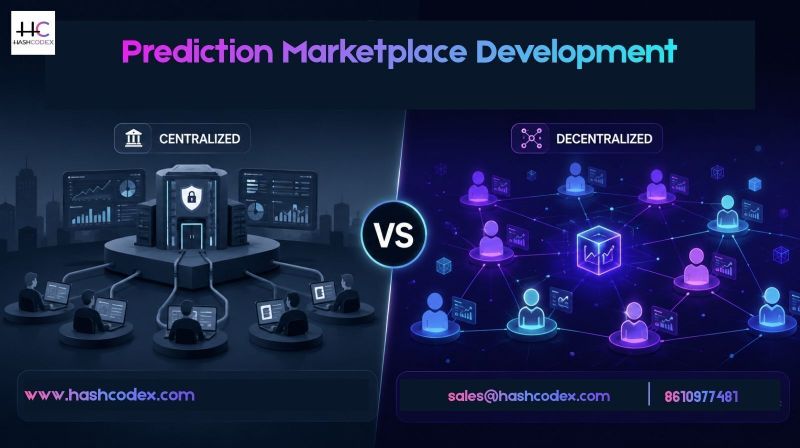
Before investing in prediction marketplace development, one important decision must be made: should the platform follow a centralized or decentralized model?
Each approach offers unique advantages and challenges.
Understanding these differences can help business owners choose the right foundation for long-term success.
Let’s get started!
What Is a Centralized Prediction Marketplace?
A centralized prediction marketplace is managed by a single company or organization. The platform owner controls user accounts, transactions, market creation, dispute resolution, and operational policies.
Most traditional online platforms operate under this model because it provides greater control over the user experience.
What Is a Decentralized Prediction Marketplace?
A decentralized prediction marketplace operates through blockchain based systems where transactions and market activities are managed by smart contracts rather than a central authority.
Instead of depending on a company to control operations, participants interact directly with the platform's underlying network.
Centralized and Decentralized: Which Business Model Is Right for Your Prediction Platform?
User Experience
Centralized platforms usually provide a smoother experience for mainstream audiences. Registration, payments, and support are often easier to manage.
Decentralized platforms may require wallet connections and blockchain knowledge, which can limit adoption among new users.
Revenue Opportunities
Centralized businesses can generate income through transaction fees, subscriptions, premium features, advertising, and partnership programs.
Decentralized platforms often rely on trading fees, token-based ecosystems, or network participation models.
Compliance and Risk Management
A centralized platform gives business owners more control over compliance procedures and risk management strategies.
Decentralized platforms may reduce some operational responsibilities but can introduce legal complexities depending on local regulations.
Development Cost
Centralized prediction marketplaces are generally less expensive to develop and maintain because they use traditional infrastructure and technology stacks.
Decentralized prediction marketplace development often requires blockchain integration, smart contracts, and additional security audits, which can increase costs.
Platform Governance
Business owners have complete authority over platform rules, feature updates, and market management in a centralized model.
Decentralized platforms often rely on community participation or governance mechanisms, which can slow decision making.
Market Expansion
Centralized platforms may face geographical restrictions due to local regulations and licensing requirements.
Decentralized marketplaces can potentially attract a global audience, although regulatory challenges still vary across regions.
Customer Support
Centralized businesses can provide dedicated support channels to resolve disputes and answer user questions.
Decentralized platforms typically offer limited direct support because many processes are automated.
Data Ownership and Transparency
In a centralized marketplace, platform operators manage and store user data.
In a decentralized environment, transaction records are often publicly verifiable, providing greater transparency for participants.
Long Term Business Control
A centralized model gives founders greater control over branding, pricing strategies, partnerships, and future direction.
A decentralized model may offer more openness but can reduce direct control over certain platform decisions.
Which Model Is Better for Business Owners?
The answer depends on your goals.
If your focus is on user acquisition, brand growth, operational control, and a familiar customer experience, a centralized prediction marketplace is often the preferred choice.
If transparency, global participation, and blockchain integration are key priorities, a decentralized approach may provide greater opportunities.
Some businesses are also exploring hybrid models that combine centralized user management with decentralized transaction processing. This approach aims to balance control and transparency while meeting user expectations.
👉 Need help choosing the right model? Schedule a free consultation and get expert guidance.
Final Thoughts
Choosing between a centralized and decentralized prediction marketplace is one of the most important decisions during platform planning.
The right model affects revenue generation, user adoption, compliance requirements, and future growth.
Before starting prediction marketplace development, business owners should evaluate their target audience, budget, operational capabilities, and long-term objectives.
A clear strategy at the beginning can help create a platform that delivers sustainable growth and a strong market position.



Top comments (0)